The Rise of Adaptive Pathways: Personalized Learning at Scale
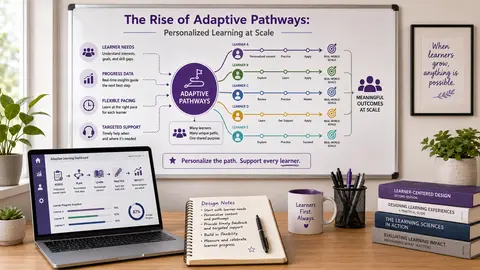
Personalized learning has long been a goal in education and training. Good teachers and designers have always adjusted examples, offered more support, and challenged learners when they were ready. What is changing now is the scale at which that responsiveness can happen.
Adaptive pathways make it possible for parts of a learning experience to respond to the learner. The route can shift based on prior knowledge, performance, pace, or need. That creates exciting opportunities, but it also raises an important question: how do we personalize learning without losing purpose, equity, learner agency, or human connection?
From Fixed Pathways to Responsive Pathways
Many learning experiences still follow a single straight road. Everyone starts at the same point, moves through the same sequence, and receives the same practice. That structure can be helpful because it creates clarity and shared outcomes.
But learners are not identical. They come with different backgrounds, strengths, gaps, goals, and amounts of time available to learn. Adaptive pathways try to account for those differences by changing parts of the experience as the learner progresses. That might mean:
- Adjusting the amount of practice
- Changing the difficulty level
- Offering different feedback
- Showing different resources
- Directing the learner to a different next activity
The goal is not to create an entirely separate course for every person. The goal is to offer the right support at the right moment so learners can keep moving forward.
Why Personalization Matters
One-size-fits-all learning often assumes that everyone needs the same thing at the same time. In reality, that is rarely true. Imagine two learners in the same training. One has years of experience. The other is brand new. If both are asked to complete the same introductory practice, the experienced learner may feel slowed down, while the newer learner may still need more support.
Adaptive pathways create a better alternative. The experienced learner might move into a more challenging scenario. The newer learner might receive another example or more practice. Both are still working toward the same goal, but they take different routes. That distinction matters. Personalization does not have to mean different standards.
The Responsibilities That Come With Adaptation
The more a system influences what a learner sees next, the more important it becomes to understand how those decisions are made. Designers and educators need to consider:
- What data is being collected
- What evidence triggers a pathway change
- Whether the system may introduce bias
- Whether a temporary struggle could become a permanent label
Adaptive learning should expand possibility, not quietly narrow it. It should support growth, preserve learner agency, and keep human judgment in the loop when the stakes are high.
Three Important Shifts in Adaptive Design
Shift #1: From the same path to a shared destination
A helpful way to think about adaptive learning is like navigation. Different travelers can use different routes to reach the same destination. One may take the highway. Another may avoid traffic. Another may need a route with fewer obstacles.
Learning can work the same way. One learner may need an example. Another may need extra practice. Another may be ready to apply the concept immediately. The important part is that the adaptation still supports the same learning objective.
Shift #2: From extra content to responsive support
When a learner struggles, the answer is not always more content. More is not always better. If someone does not understand an explanation, giving them another page of the same explanation may not help. They may need:
- A worked example
- A different explanation
- Feedback on a misconception
- Smaller steps
- A chance to talk to another person
Adaptive design should ask not, “What else can we give this learner?” but rather, “What would actually help this learner move forward?”
Shift #3: From automated decisions to designer-guided adaptation
Adaptive does not mean automatic should equal unquestioned. If a system recommends a different pathway, designers still need to decide:
- What evidence should trigger that change
- What adaptations are appropriate
- When human intervention should be available
A single incorrect response should not usually send a learner into a totally different path. But a repeated pattern of misunderstanding might signal the need for more practice or another explanation. The key is to design systems that support movement, growth, and agency rather than trapping learners in labels.
A Simple Way to Start Thinking Adaptively
You do not need a sophisticated platform to begin designing adaptive experiences. You can start by looking at one part of a course, lesson, or training where learners commonly differ. Use this three-part check:
- Where do learners vary?
- Do some learners arrive with more prior knowledge?
- Do some need more practice? Do others need a different form of support?
Identify one meaningful difference. What evidence should trigger support?
Think about what would tell you a learner needs something different. That could be:
- A practice response
- A short knowledge check
- A reflection
- A learner choice
- A pattern of performance
The adaptation should have a clear reason. What could change while the goal stays the same?
The learning goal does not need to change, but the route might. A learner could receive:
- An extra example
- Another practice opportunity
- A more challenging scenario
- A different resource
- Additional feedback
- An invitation to seek human help
Flexibility Should Be Intentional
Not every experience needs to be personalized. Sometimes a shared case study, discussion, foundational concept, or collaborative activity is exactly what learners need. Future-ready design is not about making every experience individual. It is about identifying where flexibility adds value.
The better question is not, “How personalized can we make this?” It is, “Where would personalization genuinely help this learner move forward?”
Key Takeaways
Adaptive pathways allow parts of the learning experience to respond to learner needs, performance, or progress. Personalization does not have to mean different standards. Learners can take different routes toward shared outcomes. Effective adaptation provides the right support rather than simply more content. Adaptive technology should support, not replace, designer judgment, learner agency, equity, and human connection.
Final Thoughts
The future of personalized learning is not about creating ten different courses for ten different people. It is about designing learning experiences that know when to offer another way forward. Learners should always remain more important than the algorithm.
When adaptive pathways are designed intentionally, technology can help create flexibility at a scale that would be difficult to manage manually. The challenge is to use that flexibility in service of growth, not control.
🖼️ Image Disclosure: This featured image was generated with AI using ChatGPT and reviewed by the author.

Award-Winning Instructional Designer, College Professor, Consultant, and Podcast Host
Jackie Pelegrin is an award-winning instructional designer, adjunct instructor at Grand Canyon University, podcast host, and consultant. Her experience spans higher education and corporate learning, and she holds an MBA and a master’s degree in Instructional Design and Technology. An Arizona native, Jackie enjoys reading, movies, games, and time with family and friends.
How to Move Beyond Content in Learning Design: Insights from Nicole Weber