How to Transition from Counseling to Instructional Design: Insights from Naomi Allen

As professionals in education and instructional design, we often find ourselves at a crossroads, considering new paths that align more closely with our passions and skills. In this blog post, we explore the inspiring journey of Naomi Allen, who transitioned from a master's program in clinical mental health counseling to instructional design. This shift not only reflects her evolving interests but also highlights the potential within the instructional design field to impact education positively.
About Naomi Allen
Naomi recently completed her master's degree in instructional design at Grand Canyon University (GCU). With a background in psychology and a passion for education, Naomi brings a unique perspective to the field. Her experience in higher education and her work in learning and development have equipped her with valuable insights into creating impactful learning experiences.
The Journey to Instructional Design
Naomi's journey began with a desire to help others as a counselor. However, while studying clinical mental health counseling, she discovered her love for education. Working in higher education opened her eyes to the potential of instructional design, where she could equip students with skills that would impact various sectors.
Naomi shared, "I realized I really enjoy the space of education, and I want to have that impact. Instead of pursuing counseling, I wanted to stay in education." This pivotal moment led her to explore instructional design, where she could combine her psychological knowledge with educational methodologies.
Innovative Learning Strategies
One of the key aspects of Naomi's work in instructional design is her focus on innovative strategies such as microlearning and scenario-based learning. These approaches are particularly effective for adult learners, allowing them to engage with content in a meaningful way.
Naomi explained, "Scenario-based learning and microlearning are all such common themes and ways to design effectively. For adult learners, we want to provide hands-on experiences that are relevant to them." By breaking down complex content into manageable chunks, Naomi enhances learner retention and engagement.
Implementing Scenario-Based Learning
An example of Naomi's application of scenario-based learning can be seen in her nursing development day presentation. She integrated role-play scenarios to help participants practice real-world applications of nursing concepts. Naomi noted, "When you break content down into smaller bits and practice it, it helps make sure that it stays relevant."
Naomi also created e-learning modules that facilitated hands-on learning experiences, demonstrating that even in a digital format, scenario-based learning can be effective. "Using discussion boards and open-ended responses allows for engagement and helps learners apply concepts to real situations," she said.
The ADDIE Model in Practice
Throughout her master's program, Naomi engaged with the ADDIE (Analysis, Design, Development, Implementation, and Evaluation) model. She found that while the model provides a structured approach to instructional design, real-world applications often require flexibility.
"When you're in the program, you see the ADDIE model as distinct parts, but in practice, it’s much more fluid. You have to adapt to different situations and collaborate across departments," Naomi explained. This adaptability is crucial in the fast-paced world of instructional design, where timelines and stakeholder input can shift rapidly.
Key Takeaways
- Passion for Education: Naomi's journey highlights the importance of pursuing your passion and finding where your skills best fit.
- Innovative Strategies: Utilizing microlearning and scenario-based learning can significantly enhance adult learning experiences.
- Flexibility in Design: Real-world instructional design requires adaptability beyond the structured models taught in academic settings.
Naomi Allen's transition from counseling to instructional design exemplifies the diverse paths one can take in the educational field. By embracing innovative strategies and remaining flexible, instructional designers can create impactful learning experiences that resonate with learners.
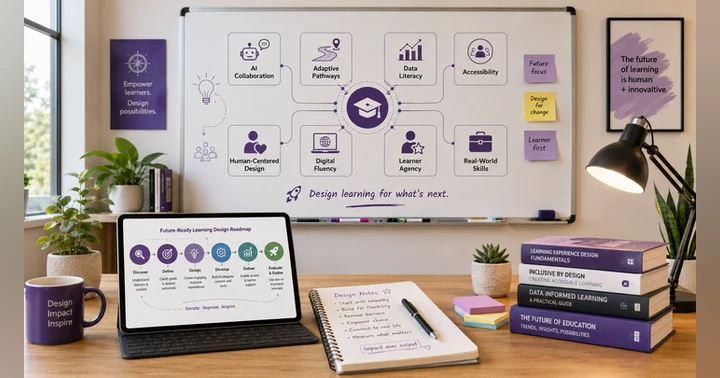
🖼️ Image Disclosure: This featured image was generated with AI using ChatGPT and reviewed by the author.

Award-Winning Instructional Designer, College Professor, Consultant, and Podcast Host
Jackie Pelegrin is an award-winning instructional designer, consultant, and adjunct instructor at Grand Canyon University. Her experience spans higher education and corporate learning, and she holds an MBA and a master’s degree in Instructional Design and Technology. An Arizona native, Jackie enjoys reading, movies, games, and time with family and friends.
Future Ready Learning: Designing Education for What Comes Next