How Game Design Can Make Learning More Meaningful With Dan Leeson

If you’ve ever tried to learn something repetitive and found your attention drifting, you’re not alone. In a conversation on Designing with Love, Dan Leeson shared how his chess training game, Chessforatu, was born from a simple problem: opening practice was useful, but boring. What followed was a thoughtful discussion about gamification, human-centered design, and how AI can support creativity without replacing the person behind the work. If you design learning experiences, teach, or create content, this conversation offers a practical framework you can use right away.
Why Repetition Becomes the Enemy of Learning
Dan’s story starts with a familiar challenge. He wanted to learn chess openings as an adult, but the available methods felt tedious. Flashcards and drill-style practice weren’t enough to hold his attention, especially once the material became repetitive. That frustration is an important design signal.
When learning feels like pure memorization, motivation drops fast. The learner may still care about the topic, but the method makes it hard to stay engaged. Dan realized that the problem wasn’t chess openings themselves - it was the experience of practicing them. That’s what led him to ask a better question: how do you make repetition feel like play?
For Dan, the answer was Chessforatu, a gothic chess training game that turns opening practice into a survival challenge. Instead of simply memorizing moves, players are trying to stay alive. If they make the wrong move, they lose health. That tiny shift changes the emotional experience of practice. This is where many learning experiences go wrong. They focus on content delivery, but ignore the learner’s attention, energy, and emotional state. Dan’s approach shows that if the content is inherently repetitive, the design has to do more of the motivational work. The lesson for educators is simple: if a task feels tedious, don’t assume the learner needs more pressure. They may need a better loop.
The Game Loop That Makes Practice Feel Rewarding
One of the most useful ideas in the conversation was Dan’s explanation of the game loop. In his words, games work because they create a cycle of action and reward. You do something, something happens, and you get feedback. That feedback can be winning, losing, surviving, advancing, or simply getting closer to a goal. That loop matters because it gives learners a reason to keep going. In Chessforatu, the loop is intentionally tight. The player makes a move, the game responds, and the player immediately sees the consequence. That structure turns a long, abstract learning goal into a series of small, meaningful decisions. It also introduces a stronger emotional hook than passive study ever could.
Dan used a few examples to show how this works in other contexts too. He pointed to Where in the World Is Carmen Sandiego? as a classic example of gamifying learning. Many people didn’t care deeply about geography or encyclopedia research - until the game made those activities part of a challenge. Suddenly, looking up facts wasn’t tedious. It was part of the fun. That’s a powerful reminder for instructional designers. People do not always resist learning itself. Often, they resist the lack of feedback, challenge, or context around the learning.
What game design teaches us about practice:
- Immediate feedback matters
- Small decisions create momentum
- Emotion supports memory
- Context gives content purpose
Dan also made an important point about chess itself: the game is less about dramatic improvement move by move and more about preserving the best possible position until the opponent slips. That idea is counterintuitive, but it highlights something deeper about learning. Sometimes progress is not about a huge visible gain. Sometimes it’s about maintaining clarity long enough to make the right next move.
AI Works Best When It Serves Your Vision
Dan’s perspective on AI was one of the strongest parts of the interview. He was clear that AI helped him move faster, but only when he stayed in control of the creative process. His analogy was excellent: if you’re building a house, you may not care how the fence gets painted, but you absolutely care where the fence goes and how tall it is. In other words, some decisions are tactical, while others are structural. AI can help with the tactical work. The human designer still needs to make the structural calls. That distinction matters more now than ever.
Dan explained that if you ask AI to create a full story, flyer, or app from scratch, it may produce something usable - but often generic. Instead, he recommends using AI as an interviewer. Rather than saying, “Write this for me,” you ask the tool to ask you the questions it needs answered. That simple shift changes everything. When AI interviews you, you stay in the operator’s seat. You’re not waiting passively for output - you’re actively shaping the result. This approach works especially well for creative projects, curriculum planning, and content creation. It keeps the human voice in the work while still benefiting from the speed and structure AI provides. Here’s the practical takeaway: AI can accelerate your process, but it should not replace your thinking.
Where AI helps most:
- Brainstorming at scale
- Structured interviews
- Low-stakes first drafts
- Iteration support
Design for the Person, Not the Process
Another major theme in the conversation was active participation. Dan’s background in improv, hospitality, immersive entertainment, podcasting, and game design gave him a broad perspective on what keeps people engaged. His answer was refreshingly simple: everyone is the main character in their own experience. That mindset changes the way you design.
Whether you’re working in education, customer service, or entertainment, the challenge is the same: you have to understand what the other person is feeling, needing, and trying to accomplish. Dan talked about this in the context of hotel work, where a guest might say the room is dirty and the response can either validate their experience or shut it down. In improv terms, the best response is to “yes, and” the situation - acknowledge the offer and move the scene forward.
That principle applies directly to teaching and learning design. If a learner says a course feels confusing, that is not a rejection to defend against. It is information to work with. If a subject matter expert wants to add more content, that is not automatically a better design choice. The question is still: what does the learner need right now?
Jackie also connected this idea to customer journey mapping - thinking through what the learner is thinking, feeling, doing, and saying. That’s a smart move. When you build a learner persona and keep that person visible during design, you’re less likely to let stakeholder preferences overwhelm the experience.
Here are a few design habits that help:
- Build around the learner’s emotional journey, not just the content outline
- Use personas or journey maps to keep real needs visible
- Treat feedback as part of the design process, not a threat to it
- Remember that participation is active, not passive
What Traditional Education Can Learn from Video Games
When Jackie asked what education could learn from video games, Dan’s answer returned to the idea of reward loops. If you want people to engage with something consistently, you need a psychological reason for them to keep going. That does not mean turning every lesson into a flashy game. It means making the experience more palatable, more responsive, and more rewarding. Dan pointed out that gamification can keep people engaged even with boring material. That’s not a gimmick - it’s a design principle. It works because not every learner opens a book and naturally absorbs everything on the page. Some people need challenge, novelty, or progression to stay with the material long enough to learn it well.
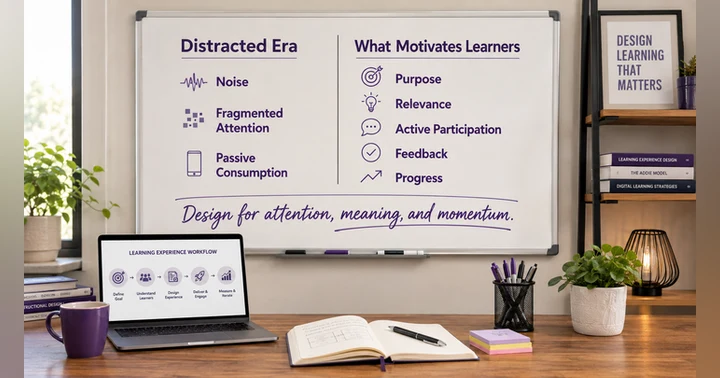
This matters even more for today’s learners, especially those growing up with constant digital stimulation. They are already surrounded by fast feedback and interactive media. If learning offers nothing but passive consumption, it will lose attention quickly. That does not mean education has to imitate every feature of a video game. But it does mean we should borrow what works:
- Clear goals
- Visible progress
- Meaningful choices
- Immediate feedback
- A reason to continue
Dan’s point was not that games are inherently better than education. It’s that good games understand motivation in a way many learning environments still ignore.
The Best Creative Work Starts with Curiosity
Dan closed with advice that applies far beyond AI tools or game design: return to your younger, more curious self. That idea may sound simple, but it’s powerful. Children approach new tools and new ideas differently. They don’t assume they already know everything. They ask questions. They stay open. They are willing to explore before judging.
For creators, that mindset is a huge advantage. If you approach a new tool like AI with fear, you’ll likely resist it. If you approach it with curiosity, you’ll learn how to use it well. The same is true for instructional design, teaching, and content creation. You don’t lose your judgment by being curious. In fact, curiosity often sharpens it. Dan also made a point that every instructional designer should hear: stay in your lane, and let subject matter experts stay in theirs. Your role is not to become the content expert. Your role is to shape learning so that the content becomes usable, engaging, and clear. That balance - curiosity plus judgment - is what keeps your work distinctive. When you combine human creativity, learner-centered design, and smart use of tools, you create something that feels alive instead of automated.
🖼️ Image Disclosure: This featured image was generated with AI using ChatGPT and reviewed by the author.

Award-Winning Instructional Designer, College Professor, Consultant, and Podcast Host
Jackie Pelegrin is an award-winning instructional designer, adjunct instructor at Grand Canyon University, podcast host, and consultant. Her experience spans higher education and corporate learning, and she holds an MBA and a master’s degree in Instructional Design and Technology. An Arizona native, Jackie enjoys reading, movies, games, and time with family and friends.
How to Motivate Learners in a Distracted Era