How to Motivate Learners in a Distracted Era
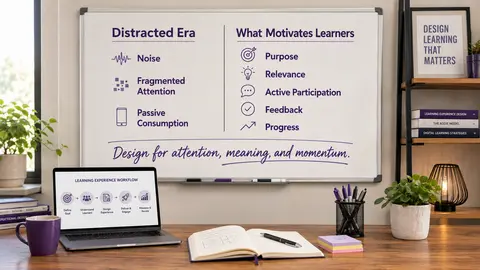
If you design learning for a living, you already know this: attention is harder to earn than ever. Notifications, multitasking, and constant digital noise mean learners are rarely sitting down with their full focus ready to go. The challenge is not to make learning louder. It is to make learning worth paying attention to. In this post, we break down the new rules of engagement for instructional designers and educators, including how to move beyond flashy distractions and build motivation that actually lasts.
Attention Is Not the Same as Motivation
A lot of learning experiences try to solve low engagement by adding more - more video, more animation, more clicks, more badges. But that approach confuses attention with motivation. Attention is the moment someone looks. Motivation is the reason they keep going.
That distinction matters because a learner can be briefly captured by something flashy and still not care enough to persist. A fast-paced video might get a click. A clever interaction might create curiosity. But if the learner does not understand why it matters, what they are supposed to do, or how they are progressing, the experience will not hold them for long.
Jackie makes this point clearly in the episode: engagement is not about keeping learners entertained every second. It is about helping them decide, “This matters, I can do this, and it is worth staying with.” That is the real design challenge in a distracted era. You are not competing with every notification on the planet. You are designing a learning experience that gives attention somewhere meaningful to land.
Why Digital Distraction Changes the Design Problem: The distraction problem is not imaginary. Across participating OECD countries, about one in three students reports being distracted by digital devices in most or every mathematics lesson (OECD, 2023). Another OECD report found that excessive digital leisure is linked with lower interest and lower motivation to learn (Forsström, S. et al., 2025). That does not mean technology is bad. In fact, digital tools can support personalization and engagement when used strategically. The problem is assuming that digital features automatically create motivation. They do not. A tool can capture attention. It cannot guarantee commitment. For that, learners need purpose, challenge, and visible progress.
Shift #1: Move from Getting Attention to Earning Attention
One of the most useful shifts in the episode is this: stop asking, “How do I grab the learner’s attention?” Start asking, “Why should the learner care?”That question changes everything. If your course opens with background information, abstract concepts, or a long explanation before the learner sees any value, you are asking for trust before you have earned it. Instead, lead with relevance. Show the learner the problem, decision, or outcome that makes the learning matter now.
For example, instead of saying: “By the end of this module, you will understand conflict management strategies.”
Try: “By the end of this module, you will have a strategy for responding when a workplace conversation becomes tense.”
The second version is better because it gives the learner a mental picture of use. They can see where the learning is going and why it matters to their work. That is what earning attention looks like. You are not begging for focus. You are making the value visible.
How to Make Relevance Visible: You do not need to rewrite every course into a dramatic story. Often, small adjustments are enough. Try these simple moves:
- Start with a realistic problem or scenario instead of a general definition.
- Connect the lesson to a task, decision, or responsibility the learner already has.
- Use language that signals application, not just understanding.
- Lead with the outcome the learner can actually use.
When relevance is clear, attention becomes a choice instead of a fight.
Shift #2: Replace Constant Stimulation with Purposeful Participation
A second trap in learning design is assuming that more interaction automatically means better engagement. It does not. If a learner has to click something every 30 seconds, that may keep them busy, but it does not necessarily help them think. And thinking is the point. Meaningful participation is not about screen activity. It is about mental involvement. What is the learner deciding, practicing, applying, retrieving, or creating? That is the question that matters.
Jackie gives a great example of what not to do: opening a module with a video, sidebar, three buttons, animation, pop-up, downloadable resource, and a discussion prompt all at once. Each element may have been added with good intentions, but together they can overwhelm the learner. When everything competes for attention, nothing earns it.
What Meaningful Participation Looks Like: Instead of asking, “How do I make this more interactive?” ask, “What is the learner doing with the learning?”
That shift helps you choose interactions that serve the outcome instead of distracting from it. Meaningful participation might include:
- Solving a realistic problem
- Making a decision and seeing its consequences
- Practicing a skill in a low-risk scenario
- Explaining a concept in their own words
- Comparing an example to a rubric or standard
- Applying feedback to improve a second attempt
Notice the pattern: these activities require thought, not just clicks. That is the difference between participation and busywork. One builds understanding. The other just fills space.
Good Interaction Has a Job to Do: Before adding any activity, ask yourself the following questions:
- What will this help the learner think about?
- What skill or decision does this practice support?
- What will the learner know or be able to do after this?
If you cannot answer those questions clearly, the interaction may not be necessary.
Shift #3: Design for Visible Progress, Not Just External Rewards
Badges, points, certificates, and rewards can be useful. They can spark interest and create momentum, especially at the beginning of a learning experience. But they are not enough on their own. External rewards can get someone to start. They rarely keep someone going for long unless the learner also feels genuine progress. That is why the episode emphasizes a deeper question: how will learners recognize that they are becoming more capable?
That is where sustainable motivation comes from. When learners can see improvement, they begin to trust the process. They are not just collecting points. They are becoming better at something.
What Visible Progress Can Look Like: Progress does not always need to be shown through a progress bar. In many cases, more meaningful indicators are available. For example:
- Feedback that explains what improved and what still needs work
- A second attempt that is clearly stronger than the first
- A skill demonstration that becomes more fluent over time
- A challenge that increases as competence grows
- A before-and-after comparison that makes growth obvious
This is important because learners often lose motivation when progress feels invisible. If they cannot tell whether they are improving, effort starts to feel pointless. But when they can say, “I understand this better than I did 10 minutes ago,” motivation begins to come from the learning itself. That is a much stronger foundation than relying only on rewards.
Feedback Should Show Growth, Not Just Correctness: Simple “right” or “wrong” feedback may be efficient, but it does not always help learners notice progress. Better feedback explains:
- What they did well
- What changed
- What to refine next
- How to use that insight in a new attempt
This turns feedback into a learning signal, not just a score.
A Simple Engagement Design Check You Can Use This Week
If you want a practical way to apply these ideas, Jackie offers a straightforward check for one lesson, module, or training activity. Ask these three questions:
Question #1: Why should the learner care?
Can the learner connect this to a real goal, problem, decision, responsibility, or experience that matters to them? If not, the learning may be technically correct but emotionally flat. Relevance is what helps learners decide to invest.
Question #2: What is the learner doing?
Not just where are they clicking. What are they thinking, deciding, practicing, retrieving, creating, or applying? This question helps you spot passive experiences disguised as interactive ones. If the learner is not mentally engaged, the activity may need redesign.
Question #3: Can the learner see progress?
How will they know they are improving? Maybe they get useful feedback. Maybe they compare early and later attempts. Maybe the challenge becomes more complex. Maybe they successfully apply a skill they could not use before. Whatever form it takes, progress should be visible enough for the learner to notice.
The Real Goal: Make Learning Worth Paying Attention To
One of the strongest ideas in the episode comes near the end: if you remove the bells and whistles from a learning experience, would learners still have a meaningful reason to engage? That is a powerful test.
It reminds us that visuals, technology, and polished production matter, but they cannot carry motivation by themselves. Underneath all of those elements, learners still need:
- A purpose
- A challenge
- Opportunities to participate
- Feedback
- Evidence that effort leads somewhere
That is the heart of future-ready engagement.
What Educators and Instructional Designers Can Control: You cannot control every notification, distraction, or competing demand in a learner’s life. But you can control what you design. However, you can do the following:
- Make the purpose clear
- Remove unnecessary friction
- Create meaningful choices
- Design for participation instead of passivity
- Show progress in ways learners can feel
That is where the real work is. Not making learning louder. Making it worth returning to.
References
Forsström, S. et al. (2025), “Key findings and integration strategies on the impact of digital technologies on students’ learning: Results from a literature review”, OECD Education Working Papers, No. 336, OECD Publishing, Paris, https://doi.org/10.1787/ab309c32-en.
OECD (2023), PISA 2022 Results (Volume II): Learning During – and From – Disruption, PISA, OECD Publishing, Paris, https://doi.org/10.1787/a97db61c-en.
🖼️ Image Disclosure: This featured image was generated with AI using ChatGPT and reviewed by the author.

Award-Winning Instructional Designer, College Professor, Consultant, and Podcast Host
Jackie Pelegrin is an award-winning instructional designer, adjunct instructor at Grand Canyon University, podcast host, and consultant. Her experience spans higher education and corporate learning, and she holds an MBA and a master’s degree in Instructional Design and Technology. An Arizona native, Jackie enjoys reading, movies, games, and time with family and friends.
How Game Design Can Make Learning More Meaningful With Dan Leeson