How to Build a Knowledge Vault for Consistent AI Output: 10 Essential Steps

In today's fast-paced digital landscape, instructional designers and educators face a challenge: producing high-quality content quickly without losing their unique voice. This post will guide you through creating a knowledge vault tailored for AI, ensuring your content remains consistent and aligned with your standards.
About Jackie Pelegrin
Jackie Pelegrin is an expert in instructional design and a host of the Designing with Love podcast. With years of experience in the field, Jackie shares valuable insights on incorporating AI into instructional design while maintaining quality and consistency.
The Importance of a Knowledge Vault
Creating content using AI can be incredibly efficient, but it comes with a significant risk: inconsistency. Without a knowledge vault, your tone, terminology, and overall quality can drift, leading to disjointed content. A knowledge vault addresses this issue by providing a centralized repository of your voice, standards, and templates.
Why You Need a Knowledge Vault
- Prevent Brand Drift: A vault helps maintain your brand’s tone across all content.
- Reduce Duplicate Work: Reuse effective phrases and ideas instead of rewriting them.
- Minimize Rework: Spend less time fixing inconsistencies by having a clear reference.
Building Your Knowledge Vault
Creating a knowledge vault doesn't have to be complicated. Here’s a simple structure you can implement quickly:
Step 1: Set Up Your Folders
Folder 1: Voice
- Include your tone guide with key descriptors (e.g., warm, clear, practical).
- Add preferred phrases and those to avoid.
- Provide a sample paragraph that embodies your voice.
Step 2: Establish Your Standards
Folder 2: Standards
- Include a quality assurance checklist.
- Outline your accessibility reminders and language guidelines.
- Document your DVRA workflow: Draft, Verify, Refine, Approve.
Step 3: Define Your Patterns
Folder 3: Patterns
- Create templates for your course structure and lesson designs.
- Include your prompt patterns.
Step 4: Document Proof of Success
Folder 4: Proof
- Collect best-performing examples, outlines, and feedback highlights.
- Showcase before-and-after improvements to illustrate quality.
Quick Starter Vault Challenge
To kick off your knowledge vault, focus on building three essential items:
- A voice guide with five key descriptors.
- A QA scan checklist covering facts, fairness, and voice.
- One exemplary piece of content that you’re proud of.
Why This Matters
By using your knowledge vault whenever you prompt AI, you ensure consistency and maintain your unique voice across all projects. This structure saves you from reinventing the wheel and allows you to focus on creativity and quality.
Conclusion
Incorporating a knowledge vault into your workflow can significantly enhance your instructional design process. Not only does it save time and effort, but it also ensures that your content remains consistent and reflective of your unique voice and standards. So take the first step today: start building your knowledge vault and watch your content quality soar.
🔗 Episode Links
Please check out the resource mentioned in the episode. Enjoy!
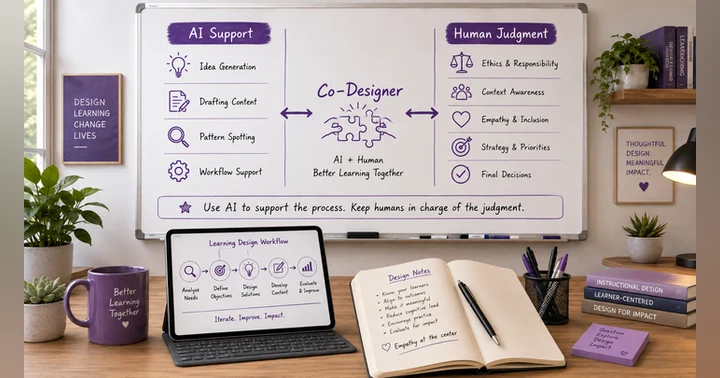
🖼️ Image Disclosure: This featured image was generated with AI using ChatGPT and reviewed by the author.

Award-Winning Instructional Designer, College Professor, Consultant, and Podcast Host
Jackie Pelegrin is an award-winning instructional designer, adjunct instructor at Grand Canyon University, podcast host, and consultant. Her experience spans higher education and corporate learning, and she holds an MBA and a master’s degree in Instructional Design and Technology. An Arizona native, Jackie enjoys reading, movies, games, and time with family and friends.
AI as Your Co-Designer: How to Use AI Without Replacing Human Judgment