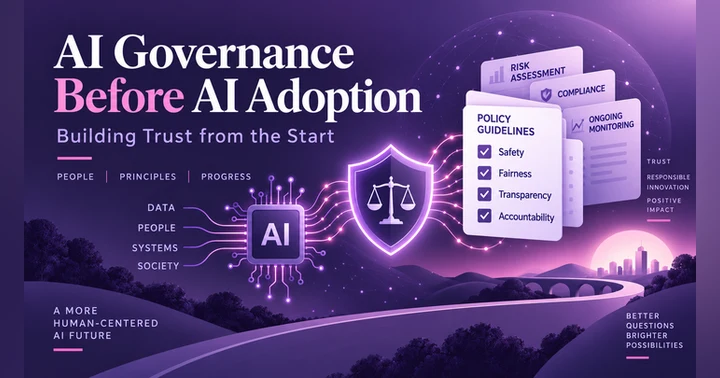
Building Responsible AI Governance With Dr. Latha Karthigaa
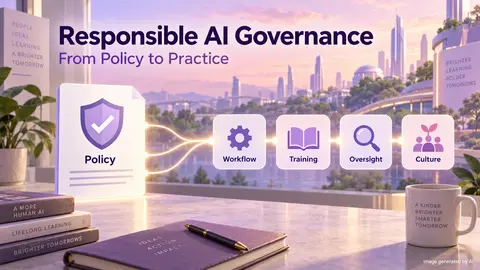
Creating an artificial intelligence policy is an important first step. But a policy sitting in a document does not automatically change how people use AI.
Responsible AI governance becomes meaningful when expectations move into everyday decisions, workflows, training, and organizational culture.
In Episode 170 of the Designing with Love podcast, Jackie continued her conversation with Dr. Latha Karthigaa about what happens after an organization establishes its AI governance foundation.
If our first conversation focused on why governance matters, this one asks the next question: How do we move responsible AI from policy into practice?
Turn Principles into Everyday Decisions
Organizations may establish strong principles around privacy, transparency, fairness, accountability, and human oversight. The challenge is translating those principles into actions employees can actually understand and follow.
People need to know what responsible AI use looks like within their roles. Some examples include:
-
Which AI tools can I use?
-
What information can I safely share with them?
-
When does AI-generated output require human review?
-
Who approves higher-risk uses?
-
What should I do if I identify a problem?
Governance becomes much more useful when employees do not have to interpret broad policy language on their own. The goal is to connect principles to real decisions people make every day.
Build Governance into Existing Workflows
Responsible AI should not function as a separate activity that employees remember only when something goes wrong. It should become part of normal organizational processes.
That could mean including AI considerations in technology procurement, project planning, quality assurance, risk assessment, or content-development workflows. For a learning team, questions might include:
- Will AI be used?
- What information will it receive?
- How will its output be reviewed?
- Could it affect learners differently?
- Who remains accountable for the final decision?
Embedding these questions into existing processes makes governance easier to sustain. Instead of adding another layer of bureaucracy, organizations can strengthen the systems they already use.
Standards Can Provide Structure
Our conversation also explored the role of frameworks such as ISO/IEC 42001, which provides organizations with a structured approach to managing artificial intelligence. Standards can help organizations think more systematically about areas such as responsibilities, risk, oversight, monitoring, and continuous improvement.
But a framework alone cannot create responsible behavior. Organizations still need people who understand why those practices matter and how they apply to their work. That brings us to one of the most important elements of AI governance: learning.
AI Governance Is Also a Training Challenge
Employees cannot follow responsible AI practices if they do not understand them. That makes AI literacy and professional learning essential parts of governance.
Training should go beyond explaining what artificial intelligence is or demonstrating how to use a particular tool. People also need opportunities to practice decisions involving privacy, accuracy, bias, transparency, and human oversight.
This creates an important role for instructional designers. We can turn policy into realistic scenarios, decision guides, simulations, job aids, and other learning experiences that help employees answer: What should I do in this situation?
That is far more useful than asking people to read a lengthy policy and remember every rule.
Governance Must Evolve with AI
AI systems are becoming increasingly capable, including the emergence of AI agents that can perform multiple actions with greater independence. As systems gain more autonomy, questions about oversight become even more important.
- Who has authorized the agent to act?
- What decisions can it make independently?
- When should a person intervene?
- How will its actions be monitored?
Governance cannot be treated as a one-time project because the technology itself will continue changing. Policies, processes, training, and risk assessments must evolve with it.
Culture Makes Governance Sustainable
Ultimately, responsible AI cannot depend entirely on rules. It also requires a culture in which people feel comfortable asking questions, raising concerns, challenging an AI-generated result, and slowing down when something does not seem right.
The strongest organizations will not force employees to choose between innovation and responsibility. They will create an environment where both can coexist.
Employees should feel empowered to experiment thoughtfully while understanding the boundaries designed to protect people, information, and the organization. That is when governance moves beyond compliance and becomes part of organizational culture.
From Policy to Practice
Responsible AI governance is not complete when the policy is published. That is where the work begins.
Organizations need to connect governance to workflows, provide clear ownership, build AI literacy, prepare for increasingly autonomous systems, and create a culture in which human judgment remains central.
The goal is not to prevent innovation. It is to create the conditions for responsible innovation that people can trust.
Policies establish expectations. People and processes bring them to life.
🖼️ Image Disclosure: This featured image was generated with AI using ChatGPT and reviewed by the author.

Award-Winning Instructional Designer, College Professor, Consultant, and Podcast Host
Jackie Pelegrin is an award-winning instructional designer, adjunct instructor at Grand Canyon University, podcast host, and consultant. Her experience spans higher education and corporate learning, and she holds an MBA and a master’s degree in Instructional Design and Technology. An Arizona native, Jackie enjoys reading, movies, games, and time with family and friends.
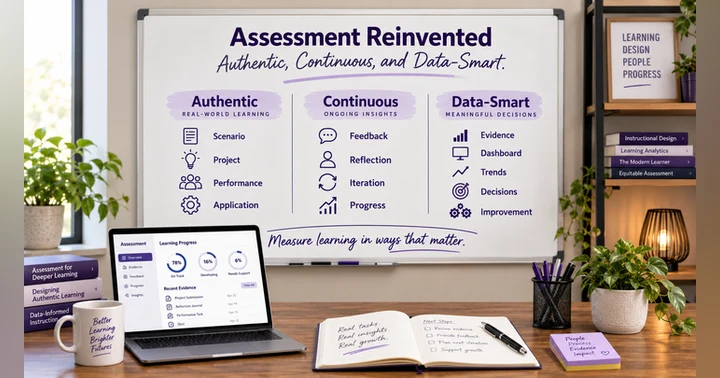
Assessment Reinvented: Authentic, Continuous, and Data-Smart