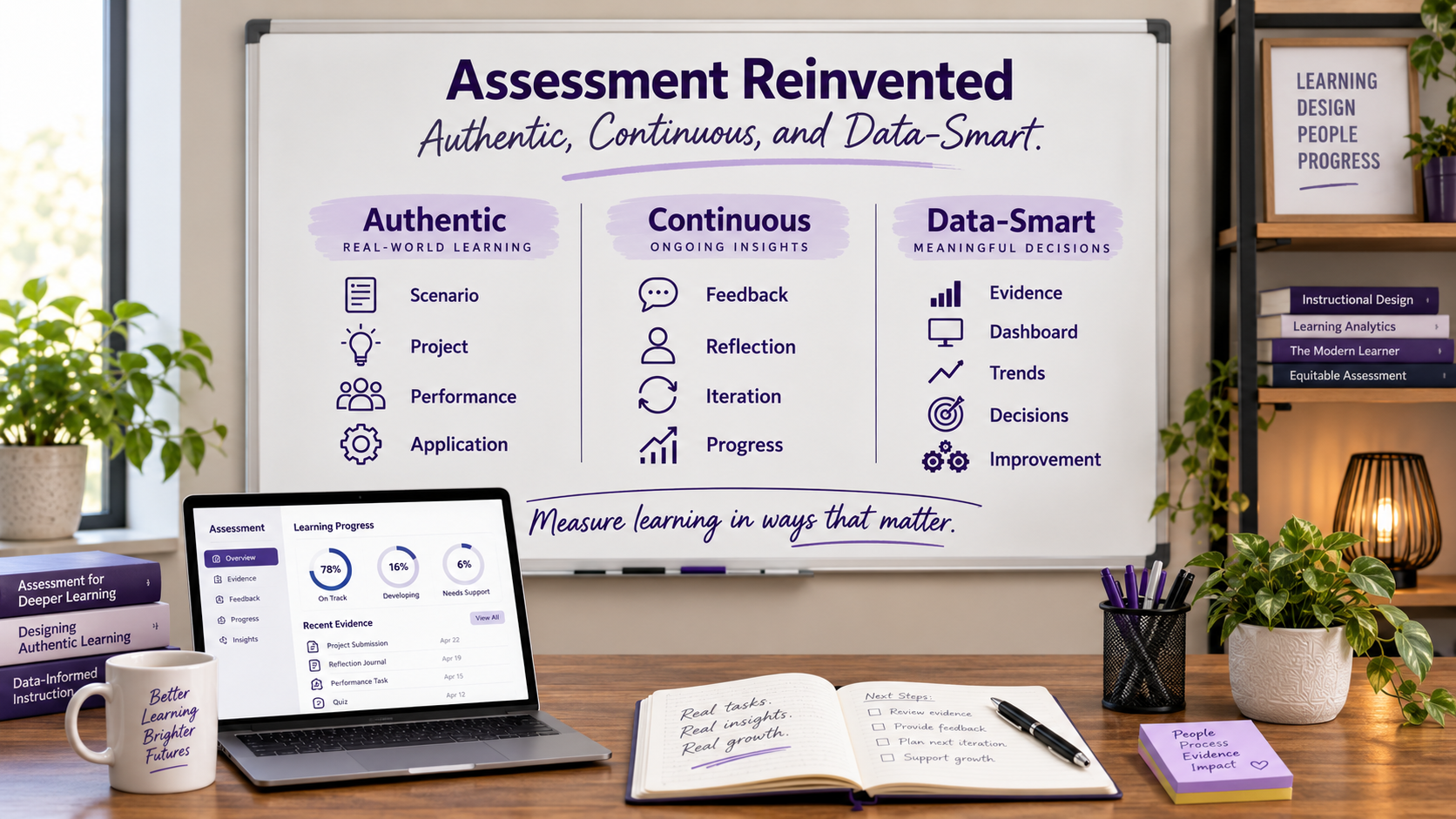
Assessment Reinvented: Authentic, Continuous, and Data-Smart
For years, assessment has often been treated as the final step in the learning process. Learners complete a course, take a test, receive a score, and move on.
But what if assessment did more than measure what happened at the end? What if it helped learners recognize what they understand, identify where they need support, apply their knowledge in realistic situations, and improve their work over time?
As learning environments evolve, our approach to assessment must evolve with them. Future-ready assessment is not simply about replacing traditional tests with newer technology. It is about reconsidering what meaningful evidence of learning actually looks like.
The central idea is simple: Assessment should not be something that only happens after learning. It should help learning happen.
Why Traditional Assessment Is No Longer Enough
Traditional quizzes and exams can still serve a purpose. They may help determine whether learners remember essential terminology, recognize important concepts, or understand foundational information. The problem arises when recall becomes the primary, or only, evidence of learning.
A learner may be able to select the correct response on a multiple-choice test without knowing how to apply that knowledge in an authentic situation. Another learner may understand the material but struggle to demonstrate that understanding through a single timed exam. Meanwhile, instructors and designers may receive a collection of scores without gaining enough information to determine what learners need next.
Reinventing assessment requires three important shifts:
-
Moving from recall to authentic evidence
-
Moving from one major assessment to continuous evidence
-
Moving from more data to smarter, actionable data
Shift #1: From Recall to Authentic Evidence
The first shift is from asking learners what they remember to asking them what they can do with what they have learned. Authentic assessments mirror the decisions, challenges, and tasks learners are likely to encounter outside the course. Rather than simply repeating information, learners must interpret a situation, make a decision, create something, or explain their reasoning.
For example, instead of asking employees to identify the definition of workplace conflict, an assessment could present a realistic conflict between two colleagues. Learners might determine how they would respond, explain why they selected that approach, and identify the communication principles guiding their decision.
In an accessibility course, learners could review an instructional resource and identify potential barriers. They could then recommend specific changes that would make the resource more inclusive.
In a course involving artificial intelligence, learners might evaluate an AI-generated response for accuracy, bias, ethical concerns, and usefulness rather than merely answering questions about what an AI tool can do.
These assessments reveal something that a recall-based quiz often cannot: whether learners can transfer their knowledge into practice.
Authentic assessment does not have to be elaborate. It could involve a short scenario, a brief demonstration, a design critique, a reflection, or a decision-making exercise. The goal is not to make every assessment bigger. The goal is to make the evidence more meaningful.
Shift #2: From One Big Moment to Continuous Evidence
The second shift is from relying on one high-stakes assessment to gathering evidence throughout the learning experience. When a single exam, presentation, or final project carries most of the weight, learners may feel that they have only one opportunity to demonstrate what they know. By the time they receive feedback, the learning experience may already be over.
Continuous assessment creates multiple opportunities for learners to check their understanding, receive guidance, and make improvements.
Evidence of learning might come from:
-
A short knowledge check
-
A response to a realistic scenario
-
An early project draft
-
Peer feedback
-
A self-assessment
-
A reflection
-
A skill demonstration
-
A revised submission
Each checkpoint serves a purpose. Some help learners practice. Others help instructors identify misconceptions. Still others encourage reflection or document growth. This approach changes feedback from a final judgment into part of the learning process.
Instead of telling a learner what went wrong after everything is finished, we can provide guidance while there is still time to use it. Learners can revise their thinking, try another strategy, and submit stronger work.
The process becomes a cycle: Evidence → Feedback → Next Step → New Evidence
That cycle supports learning far more effectively than a score delivered at the end with no opportunity to respond.
Continuous assessment does not mean constantly testing learners. In fact, too many checkpoints can become distracting or overwhelming. The goal is to place intentional opportunities for evidence and feedback at the moments when they will be most useful.
Shift #3: From More Data to Smarter Data
Digital learning platforms can collect an enormous amount of information. We can track scores, completion rates, attempts, response times, clicks, participation, and many other behaviors. But collecting more data does not automatically lead to better learning.
The most important question is not, “How much data can we collect?” It is, “What will this information help us understand or improve?”
A final score may tell us that a learner struggled, but it may not tell us why. Did the learner misunderstand a concept? Misinterpret the instructions? Need additional practice? Encounter an accessibility barrier? Struggle to transfer knowledge into a new situation?
Smarter assessment data helps us identify patterns and determine an appropriate next step. Useful data might reveal that learners consistently struggle with a particular scenario, that one question is being misinterpreted, or that learners understand a concept but need more support applying it.
That information can guide decisions such as:
-
Revising an explanation
-
Providing another example
-
Offering targeted practice
-
Adjusting the difficulty of an activity
-
Improving instructions
-
Reconsidering the assessment itself
Data should support human judgment rather than replace it. A dashboard can identify a pattern, but an instructor, facilitator, or designer still needs to interpret what that pattern might mean.
We must also remain thoughtful about privacy and transparency. Learners should not feel as though every action is being monitored simply because the technology makes monitoring possible. Data collection should have a clear instructional purpose and be limited to information that genuinely supports learning or program improvement.
Putting the Three Shifts Together
Imagine a workplace accessibility training program. A traditional assessment might conclude with a multiple-choice quiz asking employees to identify accessibility principles.
A reinvented assessment could begin with a short knowledge check and then ask learners to review a sample workplace document or training resource. Learners would identify potential barriers, explain why those barriers matter, and recommend improvements.
They might receive feedback, revise their recommendations, and reflect on how they will apply the same process in their own work. The organization could then review patterns across the responses. If many employees overlook the same accessibility issue, the training team would have actionable information for improving future instruction.
This approach incorporates all three shifts:
-
The task produces authentic evidence because learners apply accessibility principles.
-
The feedback and revision process creates continuous evidence of growth.
-
The response patterns generate actionable data that can improve the learning experience.
The assessment does not merely determine whether learners passed. It helps them develop a skill.
The Assessment Reinvention Check
When reviewing an existing assessment, begin with three questions.
Question #1: Is it authentic?
Does the assessment ask learners to use their knowledge in a meaningful context, or does it primarily ask them to repeat information? Consider whether a scenario, demonstration, critique, creation task, or decision-making activity would provide stronger evidence.
Question #2: Is there an opportunity to improve?
Can learners receive feedback and use it, or does the assessment end as soon as the work is submitted? Even one revision opportunity can transform assessment into a more powerful learning experience.
Question #3: Is the data actionable?
Will the results help the learner, instructor, or organization determine what should happen next? If an assessment produces a score but no useful insight, reconsider what evidence is being collected and why.
These questions do not require you to rebuild every assessment at once. Choose one existing activity and make one purposeful improvement.
You might replace several recall questions with a realistic scenario. You might add feedback before the final submission. You might review whether the data you are collecting actually informs a decision. Small changes can make assessment more meaningful, supportive, and aligned with the skills learners truly need.
Assessment as Part of Learning
Future-ready assessment is not about eliminating quizzes, grades, or traditional evaluation methods entirely. It is about using them intentionally and recognizing when another form of evidence would tell us more.
The strongest assessments do more than document performance. They help learners think, practice, receive feedback, reflect, and improve.
As John Dewey observed:
“Failure is instructive. The person who really thinks learns quite as much from his failures as from his successes.”
Assessment should give learners space to learn from both.
When assessment becomes authentic, continuous, and data-smart, it stops functioning solely as an endpoint. It becomes part of the learning journey itself.
🖼️ Image Disclosure: This featured image was generated with AI using ChatGPT and reviewed by the author.

Award-Winning Instructional Designer, College Professor, Consultant, and Podcast Host
Jackie Pelegrin is an award-winning instructional designer, adjunct instructor at Grand Canyon University, podcast host, and consultant. Her experience spans higher education and corporate learning, and she holds an MBA and a master’s degree in Instructional Design and Technology. An Arizona native, Jackie enjoys reading, movies, games, and time with family and friends.
AI Governance Before AI Adoption With Dr. Latha Karthigaa