🍎September 2026 Newsletter
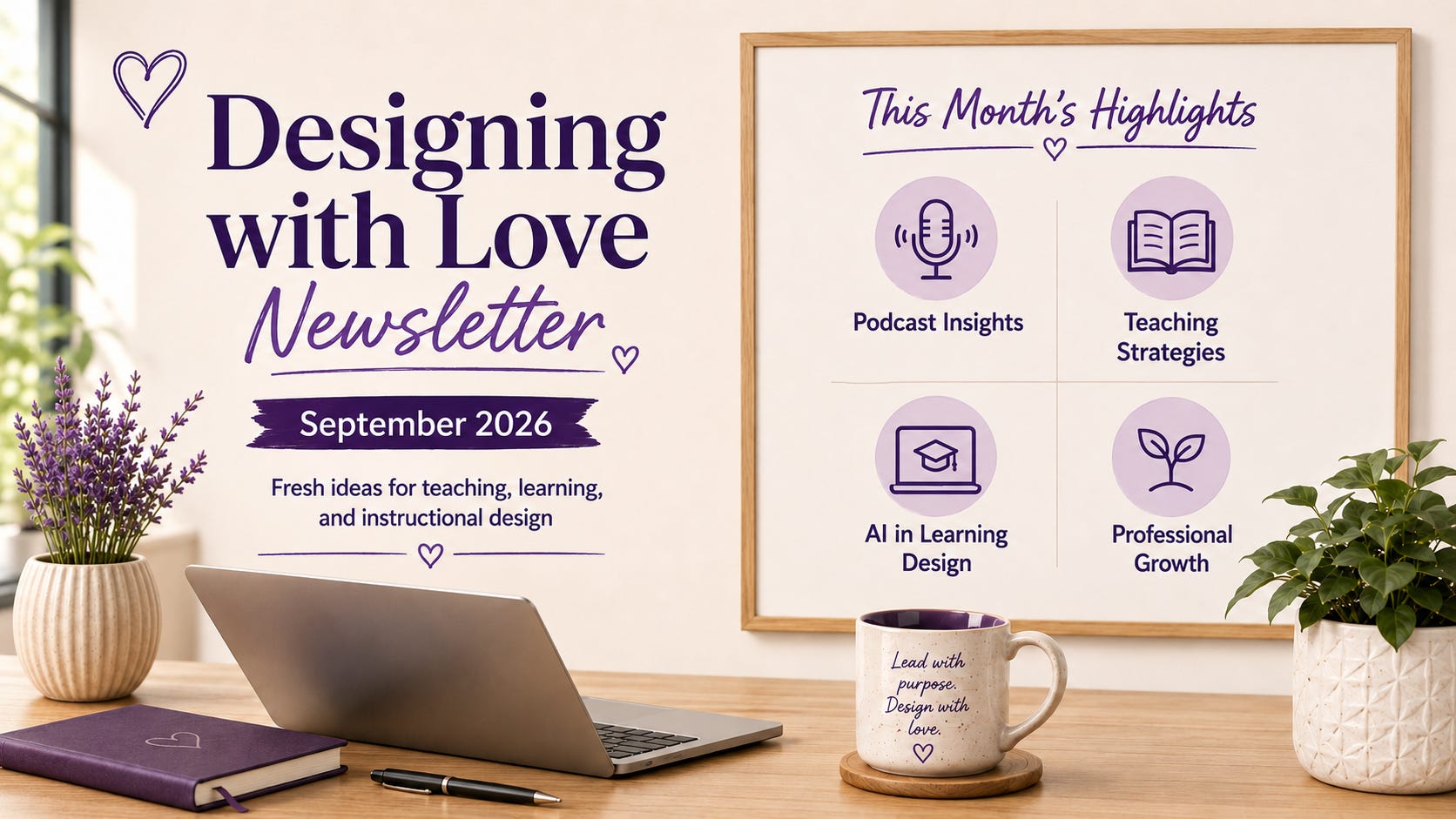
Hello, Designing with Love listeners and readers! 🩷
Welcome back to the monthly roundup! This month on Designing with Love, we had an incredible time exploring the intersection of human-centered instructional design, emerging technology, and meaningful learning. We tackled common myths in education, discussed game-based learning and legacy-building naming traditions, and shared deep-dive blog posts on microlearning and AI in writing. Here’s a rundown of what we’ve been up to over the past month.
🎙️Episodes
Game-Based Learning Can Make Security Training Stick With Lee Anderson
Your inbox is designed for speed, and attackers know how to exploit urgency and fear to trigger an amygdala hijack that shuts down clear thinking. Jackie sat down with cybersecurity expert Lee Anderson to unpack how human-centered learning design and gamification can change security behavior without relying on shame. They discussed Lee’s card game, Hack Attack: Defense, which teaches cybersecurity concepts through play and real-world practice. We also explored how AI can help teams rewrite technical guidance into clearer, more personal messaging for busy schedules. If you want cybersecurity training that truly sticks, be sure to listen to the episode, share it with a colleague, and leave a review. Visit Game-Based Learning Can Make Security Training Stick With Lee Anderson to listen now.
Myth: Engagement Means Entertainment
Clicking, laughing, and having fun can look like active participation, but equating entertainment with true engagement is a stubborn instructional design myth. In this episode, Jackie unpacks why this misconception persists in classrooms, eLearning, and workplace training when we feel pressured to constantly add flashy visuals or games. Real learner engagement goes much deeper into attention, relevance, effort, reflection, and application rather than just surface-level activity. Listeners will walk away with practical, purpose-based engagement strategies like decision-making scenarios and low-stakes practice with feedback. Grab the companion myth reset case file and try out the weekly challenge by tuning in today. Check out the full episode at Myth: Engagement Means Entertainment.
A Name Can Be the First Blueprint for Identity With Dr. Tamara Nall
A suffix can look like a tiny detail on paper, but it can carry an entire family story, pride, courage, and a deep sense of purpose. Jackie sat down with Dr. Tamara Nall to discuss Junia, a formal naming tradition designed to give daughters the kind of visible legacy marker that society has long given sons. The conversation opens up into a broader look at identity, representation, and how inclusive learning experiences and cultural change shape how people learn and belong. You will walk away with a deeper appreciation for women’s history, maternal legacy, and how curiosity about ancestry deepens self-understanding. Listen to this powerful conversation and share your most meaningful family name story by visiting A Name Can Be the First Blueprint for Identity With Dr. Tamara Nall.
Myth: Assessments Must Be Tests to Be Valid
A quiz can be quick and easy to score, but does it actually prove genuine learning or just measure memorization? In this episode, Jackie takes on the stubborn instructional design myth that traditional tests are the absolute gold standard of validity. By utilizing backward design, educators can focus on the quality of evidence needed and implement case studies, branching scenarios, simulations, or portfolios to capture authentic performance. You will leave with a simple myth reset challenge to review your own assessments and ensure they measure what truly matters. Learn more and listen to the episode by heading over to Myth: Assessments Must Be Tests to Be Valid.
📄Posts
How Game Design Can Make Learning More Meaningful With Dan Leeson
If you have ever tried to learn something repetitive and found your attention drifting, you are certainly not alone in your frustration. In this blog post, we explore Dan Leeson’s chess training game, Chessforatu, which was born from the simple problem of making opening practice feel less tedious. We break down the vital concept of the game loop, showing how cycling action, reward, and survival mechanics can transform passive memorization into an engaging experience. The core lesson for educators is that if a learning task feels tedious, you shouldn’t just apply more pressure, but rather design a better feedback loop. Read the complete article to level up your course design by visiting How Game Design Can Make Learning More Meaningful With Dan Leeson.
Boosting Young Lives: The Importance of Teaching Life Skills With Rob Heller
In an age where academic achievement often overshadows essential life skills, Rob Heller, founder of the Boost Program, emphasizes teaching youth critical abilities like communication, resilience, and teamwork. This blog post dives into the three core pillars of the program: people skills, character skills, and mindset skills, which are crucial for developing well-rounded individuals. Rob argues that just as math and science are taught, soft skills should be intentionally and systematically integrated into educational curricula. Discover how to better bridge the gap between theoretical knowledge and practical application by reading the full post at Boosting Young Lives: The Importance of Teaching Life Skills With Rob Heller.
Microlearning 2.0: Beyond Short Videos and Quick Tips
Microlearning is frequently talked about, but it is often defined too narrowly as simply a two-minute video, a quick tip, or a bite-sized infographic. In this post, we unpack what microlearning 2.0 really means, shifting our focus away from simply shrinking content length to designing learning moments that truly support performance at the exact point of need. Shorter does not automatically mean effective if the learning experience remains confusing, scattered, or disconnected from actual real-world use. The real question we must ask is what the learner needs from a small moment of instruction to successfully apply their skills. Dive into the full write-up over at Microlearning 2.0: Beyond Short Videos and Quick Tips.
Creating with AI: Balancing Technology and Human Creativity in Writing With Michael Leggs
As artificial intelligence increasingly shapes our writing processes, educators face the exciting challenge of helping students harness these tools without sacrificing critical thinking. This blog post explores Smartleby, a tool developed by Michael Leggs that acts as a revision tutor rather than a content generator, encouraging active engagement and preserving a student’s unique voice. We discuss how information overload makes information literacy and source evaluation more crucial than ever in the modern digital classroom. Read the full insights on balancing technology and human creativity by visiting Creating with AI: Balancing Technology and Human Creativity in Writing With Michael Leggs.
😊Reviews
We are continuously humbled and inspired by the incredible feedback our listeners share about the show! Our community continues to highlight our commitment to human-centered learning design, bridging the gap between instructional strategy and modern education, and utilizing technology to empower rather than burden learners. We love reading your thoughts and appreciate everyone who takes the time to support our mission. To help us spread these conversations to even more educators and instructional designers, please consider leaving a review of your own! Here is what one of our wonderful listeners had to say:
Designing with Love Podcast (5/5 Stars): “I highly recommend Jackie Pelegrin for her exceptional ability to bridge the gap between instructional design and organizational strategy. During our collaboration on the Designing with Love podcast, I was deeply impressed by her insightful approach to breaking down departmental silos and her commitment to creating experiential learning processes that truly put the student first. Jackie possesses a unique talent for ensuring that technology serves as a tool for empowerment rather than a burden for educators and staff. Her background in marketing and business, combined with her expertise in adult learning, allows her to navigate the ‘tectonic shifts’ of modern higher education with both empathy and practical innovation. Any institution looking to modernize its curriculum while maintaining a human-centered focus would be fortunate to have her leadership.” — Read the review on Designing with Love
Thank you so much for being an essential part of our community and for reading this month’s newsletter! We hope these episodes and blog posts inspire you to rethink your approach to instructional design, gamification, assessments, and microlearning. Be sure to listen to our latest episodes, explore our in-depth blog posts, and join us next month as we continue designing learning experiences with love.