Apple Podcasts
 Spotify
 Youtube Music
 Amazon Music
 iHeartRadio
 Podcast Addict
 PocketCasts
  Podchaser
  Deezer
  PlayerFM
  Castro
  Castbox
  Goodpods
 Myth: Assessments Must Be Tests to Be Valid

Key Takeaways
- The persistent myth that assessments must be tests to be valid overlooks the fact that a test is only valid when it provides the specific evidence needed for a particular learning goal.
- Tests often remain the default choice in education and workplace training due to their familiarity, perceived objectivity, and efficiency in scoring large groups.
- True assessment validation relies on backward design, where educators and instructional designers first establish learning outcomes and then choose formats that capture authentic performance and application.
- When learning goals involve complex skills like decision-making, problem-solving, or communication, alternative assessment formats such as case studies, branching scenarios, and simulations are far more effective than standard quizzes.
- The goal of rethinking testing is not to eliminate quizzes entirely, but to ensure that the chosen assessment accurately measures what matters most to learner success.
- The weekly myth reset challenge encourages instructors to review a current course assessment and ask whether it collects the necessary evidence of learning or is simply being used out of habit.
A quiz can be quick, clean, and easy to score, but does it actually prove learning? We take on a stubborn myth in instructional design and education: that assessments must be tests to be valid. In this episode, Jackie explains why tests are so often treated as the gold standard, from the comfort of “objectivity” to the pressure for efficiency in schools, certification programs, and workplace training.
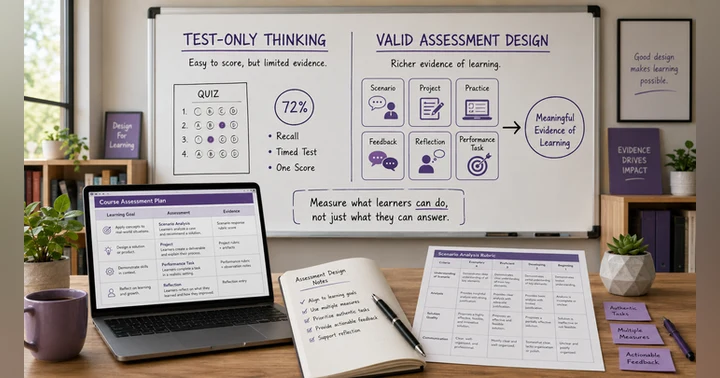
Then we make the real shift: valid assessment is about the quality of evidence, not the format. Using backward design, we start with the learning outcomes and ask what learners should be able to do and what would demonstrate it. If the goal is recall, a short quiz might be right. If the goal is application, analysis, decision making, communication, or performance, we may need case studies, branching scenarios, simulations, demonstrations, observations, checklists, portfolios, journals, or a clear rubric to capture authentic performance.
You’ll leave with a simple “myth reset” challenge: review one assessment you use and ask whether it collects the evidence you truly need or whether it’s there because it’s familiar. If you found this helpful, subscribe, share the episode with a colleague, and leave a review so more educators and learning designers can build assessments that measure what matters.
🔗 Episode Links
Please check out the resource mentioned in the episode. Enjoy!
Myth Reset Case File: Assessment Beyond Tests
Join PodMatch!
Use the link to join PodMatch, a place for hosts and guests to connect.
Disclaimer: This post contains affiliate links. If you make a purchase, I may receive a commission at no extra cost to you.
💟 Designing with Love + allows you to support the show by keeping the mic on and the ideas flowing. Click on the link above to provide your support.
☕ Buy Me a Coffee is another way you can support the show, either as a one-time gift or through a monthly subscription.
🗣️ Want to be a guest on Designing with Love? Send Jackie Pelegrin a message on PodMatch, here: Be a guest on the show
🌐 Check out the show's website here: Designing with Love
📱 Send a text to the show by clicking the Send Jackie a Text link above.
👍🏼 Please make sure to like and share this episode with others. Here's to great learning!
Frequently Asked Questions
Why are tests considered the gold standard in instructional design?
Tests are frequently treated as the gold standard because they feel objective, produce clear numerical scores, and offer unmatched efficiency when grading and tracking large groups of learners.
Are tests ever a valid form of assessment?
Yes, tests are entirely valid when the primary learning goal is to check recall, vocabulary, procedures, facts, or specific baseline knowledge.
What is assessment beyond tests?
Assessment beyond tests involves using diverse formats like case studies, simulations, portfolios, and role-plays to measure complex skills such as application, analysis, decision-making, and real-world performance.
How does backward design improve assessment strategy?
Backward design starts by identifying what learners should be able to do and what evidence demonstrates that capability, allowing the assessment format to naturally follow the required learning outcomes rather than defaulting to a standard quiz.
Welcome & Myth Series Setup
Jackie Pelegrin
Hello, and welcome to the Designing with Love Podcast. I am your host, Jackie Pellegrin, where my goal is to bring you information, tips, and tricks as an instructional designer. Hello, instructional designers and educators. Welcome to episode 143 of the Designing with Love Podcast. Today we're continuing our series called Myths and Instructional Design in Education, where we unpack common beliefs that shape how we design, teach, train, and support learning. In the last episode, we challenged the myth that more content means more learning. We talked about why learners need focused, purposeful content, not just more information. In
Why Tests Aren’t the Only Proof
Jackie Pelegrin
this episode, we're looking at another common myth. Assessments must be tests to be valid. This myth can show up when we assume that the only real way to measure learning is through a quiz, exam, or multiple choice test. But assessment is bigger than testing. A test can be useful, but it is not the only way learners can demonstrate what they know, understand, or can do. So grab your notebook, a cup of coffee, and settle in as we explore this topic together. Before we jump in, here's how this series will work. Each episode will focus on one common myth, why it has lasted, what we know instead, and how we can make stronger design decisions moving forward. Today's myth is assesses must be tests to be valid. At first, this idea can sound reasonable. Tests are familiar, structured, easy to score, and often expected in schools, colleges, certification programs, and workplace training. Tests can also be useful when they need to check recall, vocabulary, procedures, facts, or specific knowledge. So the issue is not that tests are bad. The problem begins when we treat tests as the only valid form of assessment. If we only ask learners to select the right answer, we may miss whether they can apply the concept, make a decision, solve a problem, explain their reasoning, perform a skill, or transfer learning to a real situation. A test can tell us something, but depending on the goal, it may not tell us enough. So
Why the Test Myth Persists
Jackie Pelegrin
why has this myth lasted for so long? One reason is that tests feel objective. They often produce a clear score, percentage, grade, or pass fail result. That can make them feel more valid than other assessment formats. Another reason this myth persists is that tests are efficient. They can be easier to administer, score, track, and compare across learners. In large courses or training programs, efficiency matters. This myth also persists because many of us grew up equating assessment with testing. We took quizzes, exams, midterms, finals, and standardized tests. Over time, it became easy to assume that assessment means test, but familiarity is not the same as validity. A test is only valid when it gives us the kind of evidence we actually need for the learning goal. Here's where we need to shift the conversation. The issue is not that tests do not matter, tests can absolutely have a place.
Match Evidence to Learning Goals
Jackie Pelegrin
The issue is that the assessment should match the learning goal. A more accurate way to think about it is this. Assessments are valid when they provide meaningful evidence of the learning outcome, not simply because they are tests. If the goal is for learners to remember key terms, a quiz might work well. If the goal is for learners to analyze a scenario, they may need a case study. If the goal is for learners to perform a skill, they may need a demonstration, simulation, checklist, or observation. If the goal is for learners to make decisions, they may need a branching scenario or a workplace-based task. If the goal is for learners to reflect on growth, they may need a portfolio, journal, self-assessment, or discussion. This connects closely to backward design. Instead of designing the content first and adding a test at the end, we start by asking, what should learners be able to do and what evidence would show they can do it? That evidence may be a test, but it may also be a project, performance, reflection, scenario, presentation, product, conversation, or real world task. The format should follow the evidence we need. So what does this mean for us as instructional designers, educators, trainers, or learning leaders? It means we need to move from test first thinking to evidence first assessment design. Instead of asking, what test should I give, we might ask what evidence would show that learners met the goal? Instead of asking how many questions should be on the quiz, we might ask, what do learners need to demonstrate? Instead of asking, how do I make this easy to grade? We might ask, how can I assess this fairly, clearly, and meaningfully? This does not mean every assessment needs to be complex. Sometimes a short quiz is exactly what we need. But when the outcome is application, problem solving, communication, decision making or performance, we may need a different kind of evidence.
Real Examples of Better Assessments
Jackie Pelegrin
For example, a customer service course might use a role play or scenario response. A leadership course might use a decision making case. A software training might use task demonstration. A writing course might use a portfolio. A safety course might use a simulation or checklist. The key here is alignment. The assessment should give learners a fair opportunity to show the skill, knowledge, or behavior the learning experience was designed to build. Here's today's myth reset. Instead of believing assessments must be tests to be valid, remember that valid assessment depends on the evidence it provides, not the format it uses. Tests can be useful, but they are not the only way to measure learning. When we choose assessment formats based on the learning goal, we create more meaningful opportunities for learners to show what they know and can do.
Myth Reset Challenge for Your Course
Jackie Pelegrin
This week, look at one assessment and ask yourself, does this format give me the evidence I need, or am I using it because it is familiar? That question can help us move from default testing to intentional assessment design. Today, we challenged the myth that assessments must be tests to be valid. We looked at why this belief has lasted, what it gets wrong, and how we can replace it with a more flexible and evidence-based design approach. Your myth reset challenge this week is to review one assessment you have created, taught, used, or supported. Ask yourself, what is the main learning goal? What should learners be able to do by the end? What evidence would demonstrate they can do it? Does the current assessment collect that evidence? Would another format provide a clearer picture of learning? Then, choose one improvement you can make. Maybe you revise a quiz question, add a short scenario, create a rubric, include a reflection, add a performance task, or align the assessment more closely to the goal. The goal is not to eliminate tests, the goal is to make sure that assessment actually measures what matters. In the next episode, we'll continue the series by looking at another common myth.
Quote, Resources, & Closing CTAs
Jackie Pelegrin
Engagement means entertainment. Before I conclude this episode, here's an inspiring quote from Grant Wiggins. Testing is a small part of assessment. That quote is helpful for this myth because tests can have a place, but they should not define the entire assessment process. When we think beyond tests, we can create assessments that capture application, decision making, performance, reflection, growth, and transfer. If this episode gave you something to think about, I'd love for you to share it with another educator, instructional designer, trainer, or learning leader who is ready to rethink what really works in learning. And don't forget to check out the companion myth reset case file for this episode. It will help you investigate the myth, review the design shift, and apply this week's challenge to your own course, lesson, module, or training experience. Thank you for joining me today as we open another case in our myths and instructional design and education series. As you move through the week, I hope this episode encourages you to pause before accepting a familiar belief as fact. Sometimes the best design decisions begin when we question what we have always assumed to be true. Until next time, keep learning, keep questioning, and keep designing with love. Thank you for taking some time to listen to this podcast episode today. Your support means the world to me. If you'd like to help keep the podcast going, you can share it with a friend or colleague, leave a heartfelt review, or offer a monetary contribution. Every act of support, big or small, makes a difference, and I'm truly thankful for you.