Apple Podcasts
 Spotify
 Youtube Music
 Amazon Music
 iHeartRadio
 Podcast Addict
 PocketCasts
  Podchaser
  Deezer
  PlayerFM
  Castro
  Castbox
  Goodpods
 Myth: Online Learning Is Less Effective Than In-Person

Key Takeaways
- The belief that online learning is inherently less effective than in-person learning is a myth; the true determinant of effectiveness is the quality of the instructional design, not the format itself. Poorly designed online experiences often stem from a lack of thoughtful design for the digital environment, not a fundamental flaw in online learning.
- Effectiveness in learning depends on crucial factors such as time on task, intentional instructional elements, opportunities for collaboration, and the overall quality of the learning strategy, as supported by evidence-based practices.
- Strong online learning requires intentional design elements like clear navigation, meaningful activities, purposeful interaction, timely feedback, and robust accessibility and learner support.
- Instead of asking if online learning is less effective, shift to asking what conditions learners need to succeed in a specific environment, leveraging the unique possibilities of digital formats like flexibility, reflection, and multimedia.
- Design-based decision-making involves asking what a learning activity is supposed to accomplish and what the online environment makes possible, rather than simply trying to replicate in-person experiences online.
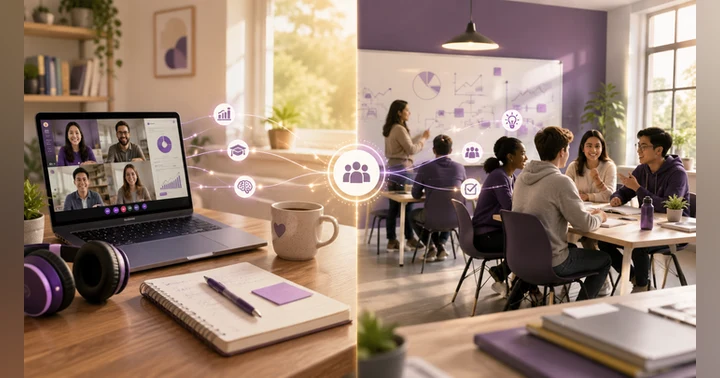
The fastest way to kill a good learning goal is to blame the format instead of fixing the design. We’re kicking off a new series on myths in instructional design and education by taking on one of the biggest, most stubborn claims out there: online learning is less effective than in-person learning.
We get why this belief sticks. A lot of digital learning has felt disconnected, confusing, passive, or overwhelming, especially when people experienced emergency remote teaching that was rushed and under-supported. But a bad online course doesn’t prove online education fails. It proves the learning experience wasn’t designed for that environment. When we stop diagnosing the medium and start diagnosing the learning, we see the real levers that drive outcomes.
We also ground the conversation in evidence-based practice, including insights from the U.S. Department of Education’s “Evaluation of Evidence-Based Practices in Online Learning.” The takeaway isn’t “online is better” or “in-person is better.” The takeaway is that performance depends on factors like time on task, instructional elements, collaboration, and the overall quality of the instructional strategy.
Then we get practical. We walk through what strong e-learning and digital learning design actually require: clear navigation, meaningful activities, interaction with purpose, timely feedback, and accessibility and learner support. You’ll leave with a simple “myth reset” challenge and a set of questions you can use to audit one lesson, module, or training and make one small improvement right away.
Subscribe, share this with a fellow educator or instructional designer, and leave a review if it helped. What’s one online course you’ve seen that could have been great with better design?
🔗 Episode Links
Please check out the resources mentioned in the episode. Enjoy!
Myth Reset Case File: Online Learning Effectiveness
U.S. Department of Education: Evaluation of Evidence-Based Practices in Online Learning
How Learning Works: Seven Research-Based Principles for Smart Teaching by Susan A. Ambrose et al.
Join PodMatch!Use the link to join PodMatch, a place for hosts and guests to connect.
Disclaimer: This post contains affiliate links. If you make a purchase, I may receive a commission at no extra cost to you.
💟 Designing with Love + allows you to support the show by keeping the mic on and the ideas flowing. Click on the link above to provide your support.
☕ Buy Me a Coffee is another way you can support the show, either as a one-time gift or through a monthly subscription.
🗣️ Want to be a guest on Designing with Love? Send Jackie Pelegrin a message on PodMatch, here: Be a guest on the show
🌐 Check out the show's website here: Designing with Love
📱 Send a text to the show by clicking the Send Jackie a Text link above.
👍🏼 Please make sure to like and share this episode with others. Here's to great learning!
Frequently Asked Questions
Is online learning really less effective than in-person learning?
No, this is a common myth. Research suggests that online learning can be as effective, and sometimes even more effective, than in-person learning when it is intentionally designed for the online environment.
What makes online learning effective?
Online learning effectiveness hinges on strong instructional design, including clear navigation, meaningful activities, purposeful interaction, timely feedback, and comprehensive learner support and accessibility.
Why do some people believe online learning is less effective?
This belief often stems from negative experiences with poorly designed online courses or emergency remote teaching. These experiences highlight design gaps rather than a failure of the online format itself.
How can I improve the effectiveness of an online learning experience?
Focus on design by ensuring clear learning paths, engaging activities, opportunities for interaction and feedback, and making sure the experience is accessible and supportive for all learners.
00:00 - Welcome & Series Kickoff
01:24 - The Myth & Why It Feels True
02:25 - Why The Belief Persists
03:55 - What Research Actually Suggests
05:10 - What Makes Online Learning Effective
06:35 - Shift From Format To Design
07:58 - Five Elements Of Strong E-Learning
09:12 - Myth Reset Challenge For The Week
10:28 - Next Myth, Quote, & Closing
Welcome & Series Kickoff
Jackie PelegrinHello, and welcome to the Designing with Love Podcast. I am your host, Jackie Pellegrin, where my goal is to bring you information, tips, and tricks as an instructional designer. Hello, instructional designers and educators. Welcome to episode 131 of the Designing with Love Podcast. Today we're beginning a new series called Myths in Instructional Design and Education, where we'll unpack some of the most common beliefs that shape how we design, teach, train, and support learning. Some myths sound practical because they offer simple answers, but learning is rarely simple. When we design from assumptions instead of evidence, we can unintentionally limit creativity, overlook learner needs, or focus on the wrong problem. In this episode, we'll explore the myth that online learning is less effective than in-person learning. We'll look at why this belief persists, what research and practice suggests instead, and what actually drives strong outcomes in digital learning environments. So grab your notebook, a cup of coffee, and settle in as we explore this topic together. Before we jump in, here's how this series will work. Each episode will focus on one common myth, why it has lasted, what we know instead, and how we can make stronger design decisions moving forward.
The Myth & Why It Feels True
Jackie PelegrinToday's myth is one of us many have heard before. Online learning is less effective than in-person learning. At first, this idea may sound reasonable. Many people have experienced online courses that feel disconnected, confusing, passive, or overwhelming. Maybe the course was mostly long readings, recorded lectures, quizzes, and discussion boards that felt forced. Or maybe the experience was shaped by emergency remote teaching when courses had to move online quickly without enough time for thoughtful redesign. So when someone says online learning does not work, they may be reacting to a real experience. But a poor online learning experience does not prove that online learning itself is ineffective. It may simply show that the experience was not designed well for that environment. When we blame the format instead of examining the design, we risk solving the wrong problem.
Why The Belief Persists
Jackie PelegrinSo why has this myth lasted for so long? One reason is that in-person learning feels familiar. For many of us, classrooms are what learning has always looked like. Because of that familiarity, in-person learning can feel more legitimate, even when the design is not especially strong. Online learning, on the other hand, makes design gaps very visible. If the instructions are unclear, learners notice. If the course is hard to navigate, learners notice. If there is no feedback or interaction, learners notice. Another reason this myth persists is that people often compare the best version of in-person learning to the weakest version of online learning. We imagine a lively classroom discussion, an engaging instructor, and immediate feedback. Then we compare that to an online course that feels like a content dump. But that is not a fair comparison. A poorly designed in-person course can fall flat, just like a poorly designed online course can. The issue is not the room or the screen. The issue is the quality of the design. Here is where we need to shift the conversation. The issue is not that the format does not matter. Format does matter. In-person, online, blended, synchronous, and asynchronous learning environments each create different opportunities and challenges. But format alone does not determine quality.
What Research Actually Suggests
Jackie PelegrinA helpful resource here is the U.S. Department of Education's report, Evaluation of Evidence-Based Practices in Online Learning. The report found that on average, students in online learning conditions perform modestly better than students receiving face-to-face instruction. But here's the important part. The report also cautioned that those results should not simply be attributed to the medium itself. In other words, it was not just online that made the difference. Factors like learning time, instructional elements, collaboration, and the overall design of the learning experience mattered too. That is why this myth is too simplistic. A more accurate way to think about it is this. Online learning is not automatically less effective than in-person learning. Learning quality depends on intentional design, clear structure, meaningful interaction, useful feedback, accessibility, and learner support. Strong online learning is not just information placed on a screen. It gives the learners a clear path. It helps them understand what they are learning and why it matters. It gives them opportunities to practice. It
What Makes Online Learning Effective
Jackie Pelegrinprovides feedback that helps them improve. And it supports learners as they move through the experience. So instead of asking, is online learning less effective? We should ask, what conditions do learners need to succeed in this environment? So what does this mean for us as instructional designers, educators, trainers, or learning leaders? It means we need to move from format-based judgment to design-based decision making. Instead of asking, how do I move this classroom activity online? We might ask, what is this activity supposed to accomplish? Instead of asking, how do I make this online course feel like a classroom? We might ask, what does this online environment make possible? Online learning can support flexibility, reflection, self-paced review, multimedia examples, branching scenarios, practice activities, and access to resources beyond a single class session. But none of that happens automatically. Technology does not design the learning, the instructional strategy does. A strong online learning experience needs a few key elements. Number one, clear navigation so learners know where to begin and what to do next. Number two, meaningful activities so learners
Shift From Format To Design
Jackie Pelegrinare doing something with the content. Number three, interaction that supports the goal, whether that is discussion, reflection, practice, feedback, or decision making. Number four, timely feedback so learners know how they are doing and how to improve. And finally, number five, accessibility and support so learners are not blocked by unnecessary barriers. When those pieces are missing, online learning can feel isolating or ineffective. But when those pieces are intentionally designed, online learning can be rigorous, flexible, relational, and meaningful. Here's today's myth reset. Instead of believing online learning is less effective than in-person learning, remember that learning effectiveness depends less on the format alone and more on the quality of the design. Online learning is not automatically weaker. In-person learning is not automatically stronger. Both can be powerful, both can fall flat. What matters is whether the experience helps learners move from where they are to where they need to be. This week, look at one lesson, module, activity, or training experience and ask yourself, am I judging the format or am I examining the design? Today we challenged the myth that
Five Elements Of Strong E-Learning
Jackie Pelegrinonline learning is less effective than in-person learning. We looked at why this belief has lasted, what gets it wrong, and how we can replace it with a more useful design approach. Your myth reset challenge this week is to review one learning experience you have designed, taught, taken, or supported. Ask yourself, is the learning path clear? Are learners doing something meaningful with the content? Is interaction built in with purpose? Is feedback helping learners improve? Are accessibility and support part of the design? Then choose one improvement you could make. It might be rewriting confusing instructions, adding a practice activity, improving feedback, simplifying navigation, adding captions or transcripts, or replacing a passive content page with a short reflection or scenario. Start small. The goal is not to redesign everything at once. The goal is to notice where one design decision could make the learning experience stronger. In the next episode, we'll continue the series by looking at another common myth. Accessibility is optional if your learners don't request it. Before I
Myth Reset Challenge For The Week
Jackie Pelegrinconclude this episode, here's an inspiring quote from How Learning Works by Susan A. Ambrose and colleagues. Learning is not something done to students, but rather something students themselves do. That quote is a helpful reminder for this myth because learning is not guaranteed by a room, a screen, a platform, or a delivery format. Learning happens when we design experiences that help learners engage, practice, reflect, receive feedback, and apply what they are learning. If this episode gave you something to think about, I'd love for you to share it with another educator, instructional designer, trainer, or learning leader who is ready to rethink what really works in learning. And don't forget to check out the companion myth reset case file for this episode. It will help you investigate the myth, review the design shift, and apply this week's challenge to your own course, lesson, module, or training experience. Thank you for joining me today as we opened the first case in our myths and instructional design and education series. As you move through the week, I hope this episode encourages you to pause before accepting a familiar belief as fact. Sometimes the best design decisions begin when
Next Myth, Quote, & Closing
Jackie Pelegrinwe question what we have always assumed to be true. Until next time, keep learning, keep questioning, and keep designing with love. Thank you for taking some time to listen to this podcast episode today. Your support means the world to me. If you'd like to help keep the podcast going, you can share it with a friend or colleague, leave a heartfelt review, or offer a monetary contribution. Every act of support, big or small, makes a difference, and I'm truly thankful for you.