Apple Podcasts
 Spotify
 Youtube Music
 Amazon Music
 iHeartRadio
 Podcast Addict
 PocketCasts
  Podchaser
  Deezer
  PlayerFM
  Castro
  Castbox
  Goodpods
 How Culture and Connection Create Real Learning With Nicole Weber


Key Takeaways
- Learning is not just about content delivery; it requires designing the right conditions for culture, connection, and psychological safety to thrive.
- Trauma-informed practices and cultural responsiveness are essential in instructional design to ensure learners feel safe enough to engage, struggle, and grow.
- Learning is fundamentally reciprocal, meaning educators and instructional designers must listen to their learners and foster a two-way exchange of ideas.
- As AI tools make information increasingly abundant, human judgment, critical thinking, interpretation, and shared meaning-making become the most valuable elements in learning design.
- Effective learning design must focus on behavior change and transfer, ensuring that learners can apply their knowledge to new, ambiguous real-world situations rather than just achieving content completion.
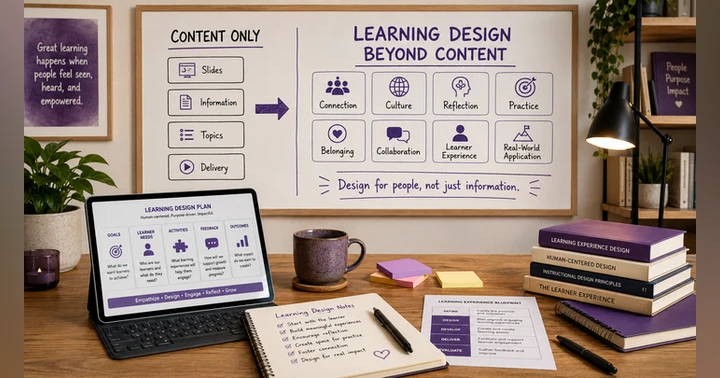
Content is the easy part. The hard part is designing conditions in which people actually learn, feel safe enough to struggle, and walk away able to use what they practiced when the stakes are real. Jackie sits down with curriculum and learning experience designer Nicole Weber to discuss human-centered instructional design that goes beyond information delivery to encompass culture, connection, and belonging.
Nicole shares how living and working abroad shaped her approach to culturally responsive learning design, inclusion, and trauma-informed practices. We unpack why learning is reciprocal, how empathy mapping can go deeper than surface-level personas, and why psychological safety determines whether the brain can stay in a learning state. We also connect the dots to evaluation and behavior change, including why organizations often stop at “completion” instead of designing for transfer.
Then we tackle AI in learning and development with a clearer question than “How do we use the tool?” When answers are abundant, what becomes valuable is interpretation, judgment, reflection, and shared meaning-making. You’ll hear a practical guiding question to ask before you build anything, plus ideas for more authentic scenarios and assessments that match the ambiguity of real work.
Follow Nicole on LinkedIn, and if this conversation helps you rethink your next course, subscribe, share it with a colleague, and leave a review so more instructional designers and educators can find it.
🔗 Website and Social Links
Please visit Nicole Weber’s website and social media links below.
📢 Call-to-Action: To learn more about Nicole’s work in curriculum design, learning experience design, and human-centered learning, visit her website and connect with her on LinkedIn. Nicole says that she believes some of the most powerful learning happens through conversation and shared reflection. She welcomes opportunities to connect with educators, instructional designers, and learning leaders who are interested in creating more human-centered, inclusive, and impactful learning experiences.
You can also reflect on today’s conversation by asking yourself: Am I designing only for content completion, or am I creating space for culture, curiosity, connection, and meaningful learning?
Join PodMatch!
Use the link to join PodMatch, a place for hosts and guests to connect.
Disclaimer: This post contains affiliate links. If you make a purchase, I may receive a commission at no extra cost to you.
💟 Designing with Love + allows you to support the show by keeping the mic on and the ideas flowing. Click on the link above to provide your support.
☕ Buy Me a Coffee is another way you can support the show, either as a one-time gift or through a monthly subscription.
🗣️ Want to be a guest on Designing with Love? Send Jackie Pelegrin a message on PodMatch, here: Be a guest on the show
🌐 Check out the show's website here: Designing with Love
📱 Send a text to the show by clicking the Send Jackie a Text link above.
👍🏼 Please make sure to like and share this episode with others. Here's to great learning!
Frequently Asked Questions
What is human-centered instructional design?
Human-centered instructional design goes beyond information delivery to focus on culture, human connection, inclusion, trauma-informed practices, and psychological safety so that learners can successfully engage and retain knowledge.
Why is psychological safety important in learning design?
Psychological safety is critical because if a learner does not feel safe, the amygdala hijacks the brain and overrides the prefrontal cortex, shutting down logic and reasoning and preventing the brain from entering a learning state.
How does AI impact modern learning experience design?
While AI efficiently generates and organizes information, it shifts the focus of learning design toward higher-order skills like human interpretation, critical judgment, empathy, and reflection rather than simple content consumption.
Why is learning considered a reciprocal relationship?
Learning is reciprocal because educators and instructional designers must be open to learning from their students, recognizing that diverse perspectives and shared dialogues transform both the learner and the community.
00:00 - Welcome & Guest Introduction
00:56 - Nicole’s Global Path to Inclusion
03:58 - Trauma-Informed Design & Learner Safety
09:40 - Beyond Content & Transferable Learning
15:34 - Curiosity, Culture, & Workplace Learning
21:15 - AI Raises the Bar for Humans
27:36 - One Question to Guide Design
30:48 - Advice, LinkedIn, & Closing Thanks
Welcome & Guest Introduction
Jackie Pelegrin
Hello, and welcome to the Designing with Love Podcast. I am your host, Jackie Pellegrin, where my goal is to bring you information, tips, and tricks as an instructional designer. Hello, instructional designers and educators. Welcome to episode 160 of the Designing with Love Podcast. I'm thrilled to have Nicole Weber with me today. Nicole is a curriculum and learning experience designer whose work explores the intersection of learning, culture, and human connection. With more than 20 years of experience in education and learning design, she creates accessible learner-centered experiences that help people grow, collaborate, and thrive. Nicole believes that meaningful learning begins with curiosity, belonging, and authentic relationships. Welcome to the show, Nicole.
SPEAKER_00
Thank you, Jackie. I really love being here today. Thank you.
Jackie Pelegrin
Yes, me too. We have about the same amount of experience. So I love that. So we will definitely have a great conversation today.
Nicole’s Global Path to Inclusion
Jackie Pelegrin
So to start off, can you tell us a little bit about yourself more than maybe what I mentioned in the intro and share how your experiences across different learning contexts shape the way you think about learning experience design?
SPEAKER_00
Oh, absolutely. Well, I spent the entire my entire adult lifehood uh living abroad and traveling internationally, primarily in Southeast Asia, but I spent a few years in the Arab Gulf as well. Um, classroom teaching, instructional leadership, you know, director, school head of schools, curriculum design, came back to the US, did some intervention. Uh, so it was like a wealth of experiences uh that have accumulated these exposures for me that have profoundly shaped how I approach my learning design. And I would say ultimately, you know, when I was transitioning from education into learning and development, at the forefront, I always kept inclusion, cultural responsiveness, and trauma-informed practices. Uh, because, you know, when you become so aware of how people are impacted in a day-to-day that it just pops up everywhere, you know, and these are just great practices to have in mind because they really allow you to dig in and explore who your learner is. Um, so obviously I'm very learner-centered in my approaches, um, having worked with so many, not even just diverse culturals, but also different education systems, understandings, you know, leadership policies and practices. Um, organizational health is really important to me, the cultural and the climate aspect. And I like to kind of stay as globally informed as I can, but locally relevant. And when I was thinking about this, um, I really it really goes back to when I studied uh service learning, uh notably with Catherine Berger Kay, and really understanding that learning is a reciprocal relationship. And even in the context, especially of service learning, it's really understanding the authenticity behind community needs. Um, you know, it's not like, oh, here are some cans of food. Oh, I did good, you know, pat myself on the back, you know. Um, but it's about really listening first and understanding where these people are coming from, you know, where you're coming from, how you think, how your lenses shape your bias, you know, um, even day-to-day normal habits, they're they're so diverse across the world. Um, like even just small things like why would I have hot soup for breakfast in the morning? You know, that just like that blew my mind and this those small nuances, you know, it's layers of an onion that, you know, you really dig deep down into and you understand that learning, it's recognizing that both learners and communities are transformed through the process of learning, you know, when reflection and demonstrated are embedded. And that's when learning becomes, you know, when learning transfers, you know, when you're able to apply what you're learning here and apply it in new contexts and extend beyond. So for me, that's always what I'm trying to figure out when I'm designing my learning experiences is who my learners are. And we talk a lot about empathy mapping, but you know, you have the superficial layer of culture and then you have like the depth of it. And I know we were talking earlier about Early Braffenbreimer, but I'll pause there because that's a very long introduction.
Trauma-Informed Design & Learner Safety
Jackie Pelegrin
That's okay. I love it. Well, and I love how Nicole, how you uh some things stood out to me as you were mentioning all of this and and your experiences and and your background and and what has shaped, you know, how you approach learning and that design today. And one of them was that it's a two-way street, right? It's reciprocal. So I think so many times I I've heard in the past, and this is I think a myth that I've I've been trying to, I've got a mythbuster series that's getting ready to come out next week. And one of them is that uh good teaching equals good instructional design. Well, you know, teachers can be really good at a lot of things, empathy and understanding their learners, right? But then teaching needs to involve more than just them lecturing at this at the students, but it also needs to involve us learning from them too. And so that's why when I teach online, I I don't just give, give, give. I expect them to give back to me too. It's uh it's a two-way street. So I love that.
SPEAKER_00
Um I mean, I do. I miss missing with kids because of the questions they asked, yes you know, because it's like, oh my goodness, I never thought about looking at it in that context. Right. Um and they just this they just really bring such a new way of seeing things. And I'm like, I learn as much from my kids as they do from me, you know.
Jackie Pelegrin
Absolutely. Yeah, I love that. That's great. I loved also how you mentioned the trauma-informed part of it because knowing where they come from and what have their experiences been, have they been through something that's going to trigger something? Yeah. We have to think about that, you know, and in our in the curriculum I work on, because I I work on counseling curriculum and social work. And today though there was a situation where we're working on a uh we're working on revising a group counseling course, and we have to meet a policy for this particular accreditor, which is uh is is for counseling. And so there's a policy that we're trying to implement into that. And one of the things I noticed as I was looking at the slide that we're going to have to present to the subject matter experts at our meeting next Tuesday, is I noticed some of the subjects were um might be triggering for some students. Like one had domestic violence, and one had, I think I'm trying to remember what the other subject was, physical abuse. And I thought, well, if they're gonna be, and then they're all mock counseling group sessions, so they don't work with real clients because it that's still a didactic course. They're not in their their field experience yet. But then I thought, well, if they're a group leader and they're facilitating and it's triggering for them, or maybe they're going through it or they've been through it, then they may not want to take that subject. So I think it's something that uh we have to be aware of when we're designing curriculum, right? That we don't trigger that percent.
SPEAKER_00
Especially like with neurodivergence, you know, really earning a place on the stage now. Umtably of ADHDers and those who are on the spectrum. And I was listening to a doctor the other day, and she's like, guaranteed, in all these cases, there's going to be trauma involved. And, you know, like when you think about individuals who are on the spectrum and the masks that they're forced to wear, you know, and even um struggling to identify, like, forget reading other people's emotions. Over half of them struggled, like just identifying, like if they're in fear or panic or anger, like it's such a complex navigation system for them. Well, well, their brain, for the most part, can think of ways like like we were talking the other day. I mean, these people are running like the IRS departments, you know, the the science institutions, like their their brains just work on levels that mind will never understand. And it's so admirable. But it's also to understand, too, that there are checks and balances in place, you know. Right. And if something triggers someone, if someone is not in, this is something I picked up very early in my teaching career is if a child does not feel safe, they will not learn full stop.
Jackie Pelegrin
Right.
SPEAKER_00
Um, yeah, yeah.
Jackie Pelegrin
There's something that blocks that brain, the brain, right?
SPEAKER_00
And oh, the amygdala completely hijacks it, yes, and overpowers the prefrontal lobe. And that logic and reasoning that you know an individual usually possesses has gone completely offline. Um so I mean the amygdala is small but powerful. Yeah, and so we have to be aware of how it works and even how it shows up in our learners, like the trauma. You you never know. Um, when I was designing um an e-learning course for the education prevention of scams, um, well, for human trafficking ultimately, but I started off with like, you know, minor scams and I built into it so that the actual facilitation was for in-person training on human trafficking that occurs, notably in the Southeast Asian areas like Cambodia, Vietnam, Thailand, because it's so predominant. You know, family thinks they're sending their little their daughter off to, you know, work on a farm in nearby village, you know, bringing some extra bucks. Next thing you know, she's in a brothel in Bangkok. And this is it's so sad because the layers of corruption are so deep. I mean, they range from bottom to top officials, you know, people who we would think are in charge of protecting public safety and who are really, you know, exposing the vulnerability in these, in in these situations. So because I also lived in Thailand for six years, um, I'm very familiar with, you know, the at-risk, the displaced people, the refugees, you know, their status, their struggle for residency and whatnot. And um, I think that was really at the forefront again with that human, with that human-centric approach, you know, the empathy mapping at the forefront and not just like their goals and their ambitions, but again, their triggers, their beliefs, their motivations, you know, what what causes them to get up in the morning? What prevents them from doing it?
Jackie Pelegrin
Right. Yeah, peeling back that onion, right? Like you said, the layers. Yeah. Really getting to the heart of it. Yes. I love that.
Beyond Content & Transferable Learning
Jackie Pelegrin
So for our topic today, we're we're centering on moving beyond content, right? Because it's not just about content creation, but focusing on that culture, connection, and the human side of learning design, which I love so much. And I'm glad we're talking about this today. So when you hear the phrase beyond content, what does that mean to you as a designer today?
SPEAKER_00
Well, for sure, content matters. You know, objectives matter, good instruction matters, you know, going back to, you know, teaching in the classroom, you were saying earlier. But content on its own doesn't create learning because learning is cultural, it's relation, it's relational, and it's contextual. So my biggest shift in thinking has been realizing that we don't just design content, we design the conditions to help people connect, to construct meaning and to sustain the change. Like learning is fundamentally human. So it happens through relationships, through curiosity, through productive struggle, you know, and more often than not, when it challenges us to think differently.
Jackie Pelegrin
Right. Oh, I love that. Absolutely. Moving beyond the content and really going to yeah, kind of goes back to what we were just talking about, that peeling down the onion and those layers. Yeah.
SPEAKER_00
I have a background in inquiry-based learning, and it always goes back to John Dewey, you know, where he really advocated that learning was social, you know, it's experience, it's reflection, it's dialogue, it's questioning, it's problem solving. It's when you don't have just the knowledge in this case, in the specific case scenario, like when you're taking an e-learning course and you're doing ABC multiple choice questions and whatnot, it's like, how can we transfer this so that the learner can take these core skills and concepts and use them in a new situation? You know, the same level of success. Or if not, then they understand how to then achieve, you know, how to get the problem solved and approach it, you know, in a constructive manner.
Jackie Pelegrin
I love that. And, you know, and and I always uh believe too in that with the inquiry-based learning, John Dewey, absolutely. And I love the fact that the, you know, learning shouldn't be an isolated incident, right? Shouldn't be just one course or one um, you know, part of it should be all interconnected, right? And and follow along with their journey as as learners. And so I yeah, I really love that inquiry-based learning myself too. That's something I'm I'm advocating for even more so today, I think, because of all the technology that's out there that can drown it out. And yeah, that's another myth I I talk about in my series is uh that technology enhances learning all the time and always doesn't. Sometimes it can muddle it, right, and make it worse, actually, sometimes. So it has to be thoughtful. Design, yes.
SPEAKER_00
I read when I was studying my master's a few um years ago, before AI even came to the forefront, Michael Fullen, uh, I think it was in his book, Stratosphere, really, really advocated if pedagogy isn't behind the learning design, it's not happening. Then it's not learning. Right. And that really made me pause. And it had a lot more impact, I think, in my future practices than I even realized. Um, because if there isn't like evidence-based learning, there's no data behind it, there's no observation, you know, there's no whether you want to do formative assessments of any kind, you don't have any reason to launch, you know, this learning, then the behavioral change isn't gonna happen. The, the, it's not going to be sustainable. So going back to like creating the conditions, you know, regular check-ins, you know, regular feedbacks, you know, connecting again with, you know, your the boss, you know, hey, do they care? Are is my am I being heard? Am I being validated? You know, you and I were talking before about um language of appreciation, you know, the love language in a workplace and how to go about it. And, you know, my husband just came home tonight exhausted, but he's like, Well, I tossed my afternoon out and helped, you know, one of my workers, you know, moving stuff around and whatnot. And, you know, and it took several hours. And I'm like, well, even though that wasn't on your to-do list and it was on hers, she's, I mean, now she's gonna, I mean, it builds those relationships, you know, it builds that connection. And if we that goes even to Ryan and Desi, you know, on the self-determination theory, the relatedness needs to be there, you know, the the the autonomy and the competency needs to be there. So there's there's a lot of fabulous frameworks out there, but obviously I'm gonna bring to the table the ones that have stood out to me the most.
Jackie Pelegrin
Right, exactly. You know, Nicole, as you were talking about all those different elements and everything. One one that came to mind was Kirkpatrick's level of evaluation, because you know, uh, and this is something I've uh that my students and I have talked about in our classes uh with Kirkpatrick's model. And so many times they reach level one and two, right? But then they struggle to do to get to three. And if they can't get, if they can't master three, then they won't get to four. So it's very important to kind of see that. Is there the behavior change? Because if there isn't behavior change, they won't get to three, and then they won't reach four. Exactly.
SPEAKER_00
Then then what are we measuring, right? Right.
Jackie Pelegrin
Exactly. Absolutely. Oh, I'd love that. So, Nicole, you mentioned earlier that you've worked across different educational and cultural contexts, including Southeast Asia and the United
Curiosity, Culture, & Workplace Learning
Jackie Pelegrin
States as well. So you have that global perspective, as you mentioned. Canada. Yeah, exactly. So how have those experiences that you've had influenced the way you design for learners, especially when it comes to those elements that we've talked about, curiosity, belonging, and meaningful connection?
SPEAKER_00
I would, I would say, you know, it wasn't it wasn't a country per se. Um, it was a training I got from the IB when I was learning under the primary years program, because I mean they call John Dewey like the father of inquiry, and inquiry and concept-based inquiry is so prevalent. And everything that I learned was, I mean, John Hattie would have loved it, you know. He's like, like, you know, all these when I read visible, you know, visible teaching, my mind was blown. And I'm like, oh my goodness, you know. So I wouldn't really say per se it was like a specific country or cultural experience. It was me always being curious, you know, always asking questions. I mean, sometimes I drive people crazy with all my questions, but you know, Trevor Mackenzie, he advocates all the time. He's like, build question competency within your learners. And I remember one time I was teaching a grade six class, and the whole period was filled with me writing down their questions. And they were like all engaged, you know, they were talking to each other. And it was just launching an ink, it was launching a new unit. I think it was light. Like, how exciting is light? This is when I was teaching the British curriculum, you know, six weeks of light, but oh my goodness, did we make it work? You know, and those kids got so curious. So it's really about it's about the curiosity and the willingness and the openness, you know, to acknowledge, like, hey, I have bias, you know, shading this perspective view. How are you seeing this? You know, and it's it's talking to people like I know like India was probably one of my favorite countries too. Um, I was up in the north in the Rajasthan area, and then down there in the south, and the women would come up and they would rub me. Now, at first, you know, as a North American, we're like, oh, don't touch me personal space, you know. Um, and then I learned that they were doing it for good luck. And I'm like, how blessed is that? You know, like you really think my white skin is gonna give you luck, you know? And but it was, and then, you know, they would chat and they they share a part of themselves every time they talk to you, you know. And when someone shares a part of themselves and they they help open your eyes to understand the world better. Because at the end of the day, we I always want to know why. Like that is my primary question. My mom was a teacher, spent 35 years in the classroom, and she's like, she's like, there was a big difference between you and I. And she's like, you always wanted to know the background of your kids. You always wanted to know what made them tick, why they behaved a certain way. And I said 100%. Because if I don't know what is causing those friction points, those constraints, those blockages, how will I ever know what they need to access to feel safe and to be open to learning?
Jackie Pelegrin
Right. Right. That's so true. Wow. And I think that can translate to workplace training too, because so many times the trainer or the facilitator will just want to get the content out there, right? And it didn't happen that way. Train it. And it's uh yeah, it doesn't happen that way. It's so funny too, because one of my coworkers, she's she's kind of new, and if she listens to this, she'll know she'll know who she is, and she'll just laugh, probably. But she's she's new in our in our department and on our team, and she'll she'll ask questions and she'll be um because you'll you'll understand what this means, and and so it's about the inquiry base, but she'll ask questions and she'll be like, please don't fire me because I'm asking all these questions. We're like, no, it's okay. That's what you're supposed to do. You're supposed to ask questions. Because how how can people remember all that's given to them in the first three weeks of training? Because a lot of people have to be able to do it, right? And and actually be part of that process, do their first course, right?
SPEAKER_00
And uh or you've got to build up that scheme of understanding, and it's a scaffolded, segmented approach for the most part.
Jackie Pelegrin
Right, exactly. And and it's okay if you can't find something in in the training material, then you can't find it. Ask, and it's okay. And so I think it's it's a culture shift, right? And it's uh behavior shift because I think so many times I I've been at companies and it's like just keep your head down and just work and then go find it. And it's like, wait, we should all be part of a community and collaborate with each other.
SPEAKER_00
Yeah, it goes back to organizational health, you know. If we don't have that culture there, how can people feel safe and comfortable and how can they be open to learning new things? Like, what's their motivation? You know, if they're being shut down, they're not being heard. Why would they want to learn something new that takes valuable time out of their day that they could be spending, you know, to knock off the tasks, you know, check off the clock and go home?
Jackie Pelegrin
Right. Exactly. And they're not going to innovate, they're not going to come up with new ideas because they're like, man, it's not going to be heard. So why should I, why should I do that? And there's some people in my department that have been there for a long time that have that mindset and that attitude. And it's like, oh, that's so sad because uh for a while there things weren't being uh taken seriously, or management would uh, you know, would implement something and then we're like, wait, all of a sudden we have to do this. And so I think they learned from that and got feedback on that, so that's good. So, you know, they've they've improved since then, but it's so true, you know, not just in the classroom, but I think in the workplace, yeah.
SPEAKER_00
I think when there's a real omission of trust and respect and humility in the it can it can be a huge shift in paradigm when the opposite is done.
Jackie Pelegrin
Right. So true. So, Nicole, you you briefly touched on AI and we talked a little bit about those technologies. Those are continuing to evolve. We're
AI Raises the Bar for Humans
Jackie Pelegrin
still kind of uh kind of at that that beginning point still. I think we're we still don't know what it where it's gonna go. Yeah. But many, yeah, many learning designers I think are are trying to understand how to use these tools well. And I think that's the that's the biggest challenge. So, in your view, what parts of learning design should remain deeply human even as technology becomes more present in our daily work?
SPEAKER_00
Yeah, we we really live in an era where we can't predict what's gonna happen, can we? Um I I think I think AI is prompting us to revisit a much bigger question is not how do we use AI, but we need to start asking ourselves, what is the purpose of learning when information is already abundant? AI, for example, you know. And I think it's really changing how many of us see the value of information. So, like for example, AI is is excels at generating, summarizing, organizing, explaining, you know? But these efficiencies also remove the very process through which people learn. So while answers are now easier to generate, the human side of interpretation, judgment, and shared meaning making becomes even more important, you know, to have that even that friction in dialogue with your peers. Like when I was studying to be an instructional designer, you know, you Learning through the modules, you're taking notes, and it's like, okay, I understand. Then you talk to your colleagues in your community, and they took something totally different. And you're like, oh my goodness, yeah, that never occurred to me, you know? And it's not even just putting things into practice in the application, it's the reflection afterwards, because that's when learning actually happens, you know. Um, so this is this is a time when judgment matters more than execution and sense making matters more than speed. Because yes, we can find information, but how are we evaluating, recognizing bias, integrating multiple perspectives? You know, these are those higher order thinking skills that have fallen to the wayside, which we need to bring right back to the forefront and keep humanity at the center, despite what novel tool it is, great. Use it as an amplifier, as a sound thinking partner, fabulous. But at the end of the day, the learning happens with the human.
Jackie Pelegrin
Oh, so important. I love that. You know, and Nicole, I had someone on my podcast yesterday that I interviewed, and he's a he's an English composition and writing professor at a college. And he said pretty, yeah, it's very similar things too. And he said, writing and and that that critical thinking and all those elements that you just mentioned are still have to come back to the forefront because we're losing that. And he even developed his own uh AI tool for them and it doesn't write for them. It's called SmartleBee, but it doesn't write for them, but it actually they can feed their rough draft or their outline into it, and uh especially like the rough draft, but it can help them kind of come up with some ideas, right? But then they still have to do the writing and then they can put their rough draft in there and say, okay, where can I improve and things like that? Then they go and they write it, get instructor feedback, right? And then they can put their final draft in there and it can actually compare the rough to the final and see, did you just make surface level changes or did you make deeper type changes? Yeah.
SPEAKER_00
Oh, very interesting.
Jackie Pelegrin
It's really neat. So he's looking at some uh different uh institutions to see where where he can test it out. So I'm really excited to see that because you know he's not competing with other tools like Grammarly or even Chat GPT, but it's more about giving them still giving them that human uh part of it and that and letting them know writing is still important.
SPEAKER_00
And oh my goodness, yeah.
Jackie Pelegrin
Yeah. Anything like that, critical thinking needs to still be around. So I'd love that you mentioned that, that that those elements need to still stay and they they have importance and in the work and everything that that we do and we ask our students to do as well.
SPEAKER_00
We we could even look at it like that AI or all the, you know, the tech and stuff that's coming out now, that it actually raises the bar in how we design our learning because now our responsibility is shifting to creating the conditions and experiences beyond the content, you know, that will cultivate, you know, the judgment and the meaningful dialogue and create create create the situations where you know learners can connect and transfer into meaningful action. You know, it's it's not just copy and paste done and done, and then they forget about it. I mean, right. It's it's hopefully, you know, I know us instructional and learning experience designers are really trying to help the L and D sphere in general really understand the various layers. And I honestly think like it, I always keep coming back to Irie Braffinbrenner's like ecological systems theory, you know, when we're talking about layers of an onion and we what's the microsystem of the learner? What's the meso system, you know, what's the exosystem? What are all the influential influencing variables? Like going even to trauma-informed design, you know, cultural responsiveness, what how does the learner think? You know, in some cultures, looking someone in the eye is very disrespectful. Here it denotes we're paying attention and we're focused.
Jackie Pelegrin
Right. So, you know, it's interesting, Nicole, because I uh, you know, those are elements that are uh in the helping professions like counseling, social work, and things like that. But I didn't learn that in my master's program. And I think I should I think we should include it in the master's programs in instructional design, learning experience design, all those elements because we are really uh teaching and all the all these types of professions that are in that. It's I think it's I think education is a helping profession too. I think it should be under that same umbrella because we are helping individuals learn. We're helping them grow and um and be able to be good citizens, right? We're yeah, we're and lifelong learners. Lifelong learners, yeah, absolutely. We're building character in them, they don't even know it sometimes. I love that. That's great. Oh, this is such a great conversation. So I wanted to do our bonus question. I love uh this is one of my favorite parts. So, Nicole, if you could ask every instructional designer
One Question to Guide Design
Jackie Pelegrin
or educator to pause and reflect on one human-centered question before designing a learning experience, what would that question be?
SPEAKER_00
Oh, I think this would kind of I'll I'll just reiterate the theme kind of that's been going on in our conversation is what conditions and experiences will you support or facilitate to connect, construct, and transfer their learning into a new context? How can they take this, these core concepts and skills and apply them in a new situation with while feeling also confident, you know, and motivated to do so? Like, because that's when it's relevant and meaningful to them. So we just to sit and think about how are you designing the conditions and experiences to move the learning past and beyond, you know, the scope of what you're currently designing to do.
Jackie Pelegrin
That's beautiful. I love that. I'm gonna have to write that. Write that one down because it'll be in this in the uh in the script. So I'll I'll be like, ooh, I'm gonna pull that one out. That's a great one. Love it. I'll have to add that to my little list of of uh questions to ask and and then maybe I can post Jackie. Yeah, pose it to my students. I can I can use it as a classroom assessment technique for my students.
SPEAKER_00
Oh, that would be when I ask myself that question, it really helps me then even go back to like the scenarios I'm designing and how authentic and realistic can I create them, you know. Um, I I really don't like multiple choice questions. I know they're very practical when we're doing you know, doing compliance and SOPs and whatnot, but ultimately, like the real world is not black and white. It's not this polarized dynamic. You know, situations are ambiguous, you know, they're unclear. They're not might not be a blanket right or wrong. It might be you choose this path and this happens, you choose this path and this will happen. And the consequences can vary. They might be positive and negative, you know, both with different weights, perhaps. But, you know, the real world isn't an ABC choice. The real world is it's not always about what's wrong and what's right, you know. Um, you know, coming back to the US, it's been really an interesting observation seeing how like the political sphere here has. And again, when we're talking about or you Roth and Brian, it's like the macro system, like this does impact the child because apologies and decisions that, you know, the state makes, that the superintendent makes, that that the teacher then makes, it carries down. It's got a trickle-down effect, you know.
Jackie Pelegrin
Um so, Nicole, as we wrap up, what advice would you give to instructional designers, educators, or learning experience designers like yourself who want to create learning that feels more connected, culturally responsive, and human-centered?
SPEAKER_00
Stay curious, man. Stay curious. Um, spend more time understanding who your learners are before you build the content. Um listen before you design. Uh, I love Stephen Kobe. Uh, you know, seek to understand before being understood. Uh ask questions before you generate your answers. Um yeah, design for humans at the center. Humanity just needs to be at the center, ultimately.
Jackie Pelegrin
Absolutely. I love it.
SPEAKER_00
People don't learn in isolation, like you said, you know, they learn through relationships, culture, reflection,
Advice, LinkedIn, & Closing Thanks
SPEAKER_00
productive struggle.
Jackie Pelegrin
So stay curious. Stay curious. Absolutely. I love it. Well, Nicole, thank you so much for joining me today and for all of your insights and your experiences that you shared with us. This was such a valuable conversation because it provides us with a helpful reminder that effective learning experiences are not built from content alone, as we talked about earlier. They're shaped by culture, curiosity, connection, and the care we bring to understanding the people we design for. That's so important. We don't want to forget that. So, for those who want to keep from learning from you, Nicole, what's the best way to follow you and connect?
SPEAKER_00
Uh, probably on LinkedIn. I'm I'm a lot more prominent on LinkedIn than I have been in the past. So, yeah, send me a message, curiosities. I love, I love thought partnership, you know, ping-ponging ideas back and forth, just digging into curiosities, questions we have, you know, when something is causing us friction and we need to close that gap, you know, can we chat? You know, thought partners are really great to have in leadership practice and cult everything in everything, you know. You always need someone to be sounding bored.
Jackie Pelegrin
Right. Absolutely. I think it's so important because then we can advocate for what we do in our profession and and get the word out a little bit more because I I still have people today that ask what I do, and I tell them I'm an instructional designer, and I get that curious, like unsure look from them, and they're like, what does that mean? What does an instructional designer do? And I'm like, you know, and when I tell them it's been around since World War II and that it was developed by the the army, right, in the military, they're like, Really? That's instructional design. I'm like, yes. You know, they're all tra they all train each other, right? So yeah, so it's very interesting when I tell them that and what I do, they're like, and then the light bulb moment happens, and I'm like, there you go, they get it. But at first, they're like, what is that? You know, I didn't even know what it was until I started my master's, right? Yeah. So I became one of those accidental instructional designers. I just, I just fell into it, didn't even realize I was doing it. So it's amazing. I I love the profession and it's it's a blessing, right, for us to be doing something that we know is is creating legacy and has impact for those learners for years to come, decades, right? Even yeah, yeah, I love it. I love being able to change lives and be able to impact one learner at a time. So it's it's uh an amazing profession to be in. So for those that aren't in it, uh, you know, if you're curious, check it out, right? Right, yeah. You never know where it'll take you. So it's it's amazing. Great. Well, I hope you come back on the podcast, Nicole, because I'd love to have you back on. The door is always open. And now that you've you've been on it once, you know the experience. And so I would love to have you back on and and be able to share some more insights with the listeners. So thank you. Wonderful.
SPEAKER_00
Thank you so much for having me. I appreciate it.
Jackie Pelegrin
You're welcome. Thank you for taking some time to listen to this podcast episode today. Your support means the world to me. If you'd like to help keep the podcast going, you can share it with a friend or colleague, leave a heartfelt review, or offer a monetary contribution. Every act of support, big or small, makes a difference, and I'm truly thankful for you.

Curriculum & Learning Experience Designer
Nicole Weber is a curriculum and learning experience designer whose work explores the intersection of learning, culture, and human connection. With more than twenty years of experience in education and learning design, she creates accessible, learner-centered experiences that help people grow, collaborate, and thrive. Nicole believes that meaningful learning begins with curiosity, belonging, and authentic relationships.