Apple Podcasts
 Spotify
 Youtube Music
 Amazon Music
 iHeartRadio
 Podcast Addict
 PocketCasts
  Podchaser
  Deezer
  PlayerFM
  Castro
  Castbox
  Goodpods
 Myth: Learning Styles Should Drive Design Decisions

Key Takeaways
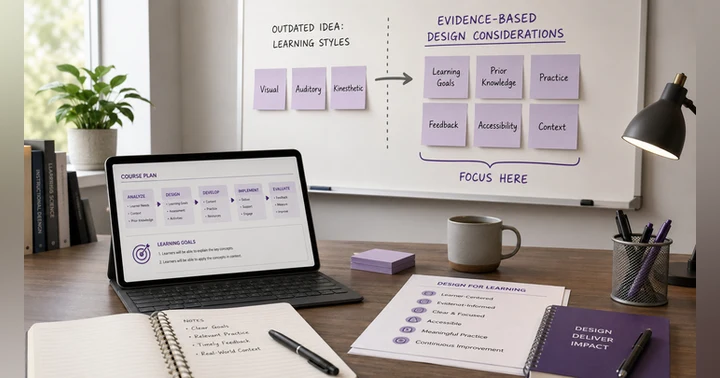
- The learning styles myth in instructional design suggests that matching instruction to a visual, auditory, reading/writing, or kinesthetic style improves outcomes, but research does not support this approach.
- While learners certainly have preferences for certain formats, treating these preferences as fixed categories can limit learners and distract from evidence-based design.
- Strong instructional design focuses on the learning goal and the specific task rather than attempting to categorize learners into rigid learning style labels.
- Accessibility is completely separate from learning styles, relying instead on inclusive practices like captions, transcripts, and keyboard navigation to remove barriers for everyone.
- The myth reset challenge encourages instructional designers to audit one learning experience this week to ensure goals, practice, feedback, and evidence-based strategies drive decisions.
If you’ve ever heard someone say “I’m a visual learner,” you’ve seen how quickly learning style labels can shape training decisions. In this episode, Jackie unpacks a persistent instructional design myth: that learning styles should drive how we build courses, lessons, and eLearning. Learner preferences are real, but treating them like fixed categories can pull us away from what actually improves performance and understanding.
Jackie explores why the myth sticks around, from how personal it feels to how neatly it simplifies something messy. Then I make the key design shift: stop asking what style a learner “is” and start asking what the learner needs to do. When the goal is understanding a process, visuals like diagrams may be the best support. When the goal is sound recognition, audio examples become essential. When the goal is decision-making, scenarios plus feedback often beat more content every time. The format serves the outcome.
We also separate accessibility from learning styles. Captions, transcripts, alt text, clear headings, readable documents, and keyboard-friendly navigation are not extras for a certain “type” of learner. They’re inclusive, responsible design choices that remove barriers for more people. To wrap up, Jackie closes the episode with a practical myth reset challenge you can use to audit one learning experience this week and make one improvement that better aligns with goals, practice, feedback, and evidence-based strategies.
If this helped you rethink how you design, subscribe, share the episode with a colleague, and leave a review so more educators and instructional designers can find the series.
🔗 Episode Links
Please check out the resources mentioned in the episode. Enjoy!
Myth Reset Case File: Learning Styles and Design Decisions
Multimedia Learning by Richard E. Mayer
Join PodMatch!
Use the link to join PodMatch, a place for hosts and guests to connect.
Disclaimer: This post contains affiliate links. If you make a purchase, I may receive a commission at no extra cost to you.
💟 Designing with Love + allows you to support the show by keeping the mic on and the ideas flowing. Click on the link above to provide your support.
☕ Buy Me a Coffee is another way you can support the show, either as a one-time gift or through a monthly subscription.
🗣️ Want to be a guest on Designing with Love? Send Jackie Pelegrin a message on PodMatch, here: Be a guest on the show
🌐 Check out the show's website here: Designing with Love
📱 Send a text to the show by clicking the Send Jackie a Text link above.
👍🏼 Please make sure to like and share this episode with others. Here's to great learning!
Frequently Asked Questions
What is the learning styles myth in instructional design?
The learning styles myth is the belief that instruction must be matched to a learner's preferred style—such as visual, auditory, or kinesthetic—in order for effective learning to occur.
Do learning styles improve educational outcomes?
Research reviews have not found strong evidence that learners perform better when instruction is tailored to a fixed learning style, though learner preferences are still real.
How should instructional designers drive design decisions instead of using learning styles?
Designers should base their choices on the specific learning goals, the tasks learners need to perform, cognitive load, feedback, and evidence-based strategies rather than learner labels.
Is accessibility the same thing as designing for learning styles?
No, accessibility is about removing barriers through inclusive features like captions, alt text, and readable documents to ensure everyone can access and navigate the content.
Welcome & Series Setup
Jackie Pelegrin
Hello, and welcome to the Designing with Love Podcast. I am your host, Jackie Pellegrin, where my goal is to bring you information, tips, and tricks as an instructional designer. Hello, instructional designers and educators. Welcome to episode 139 of the Designing with Love Podcast. Today we're continuing our series called Myths in Instructional Design and Education, where we unpack common beliefs that shape how we design, teach, train, and support learning. In the last episode, we challenged the myth that good teaching equals good instructional design. We talked about how teaching and instructional design are connected, but they are not the same role, process, or skill set. In this episode, we're looking at another common myth.
The Learning Styles Myth Defined
Jackie Pelegrin
Learning styles should drive design decisions. This myth can show up when we assume learners need instruction matched to a specific style, such as visual, auditory, reading or writing or kinesthetic. While learners may have preferences, those preferences should not be the primary driver of our design decisions. So, grab your notebook, a cup of coffee, and settle in as we explore this topic together. Before we jump in, here's how the series will work. Each episode will focus on one common myth, why it has lasted, what we know instead, and how we can make stronger design decisions moving forward. Today's myth is learning style should drive design decisions. At first, this idea sounds learner centered. It seems to honor the fact that learners are different, and as instructional designers and educators, we absolutely want to recognize learner differences. You have probably heard someone say, I'm a visual learner. I learn best by listening, or I need to do something hands-on before I understand it. Those statements usually describe learner preferences,
Why The Myth Persists
Jackie Pelegrin
and preferences are real. Some learners may prefer videos, some may prefer reading, some may enjoy diagrams, audio explanations, examples, practice activities, or discussion. But preference is not the same thing as improved learning. The myth becomes a problem when we assume that learners learn best only when instruction is matched to their preferred learning style. For example, we may think we need one version of a lesson for visual learners, another version for auditory learners, and another version for kinesthetic learners. But strong instructional design is not about matching content to a fixed learner label. Strong instructional design is about choosing the methods, media, examples, practice, feedback, and support that best fit the learning goal. So why has this myth lasted for so long? One reason is that it feels personal. When learners say, I'm a visual learner, they are often trying to explain what feels natural, comfortable, or helpful to them. And because we want to support learners, it can feel respectful to design around those preferences. Another reason this myth persists is that learning styles give us simple categories for something that is actually complex. Learning is influenced by prior knowledge, motivation, attention, practice, feedback, cognitive load, accessibility, context, and the type of tasks learners need to perform. But labels like visual, auditory, reading or writing, and kinesthetic can make learning feel easier to sort and manage. This myth also persists because many professional development sessions, teacher trainings, and learning resources have repeated the idea for years. When a concept is repeated often enough, it can start to feel like common sense, even when the evidence does not support using it as a driver of design. The challenge is that learning style labels can unintentionally limit learners. A learner might think, I am not good at reading because I am a visual learner, or I cannot learn from diagrams because I am an auditory learner. As instructional designers and educators, we do not want to place learners in boxes. We want to expand the ways they can engage, practice, and grow.
What Research & Results Show
Jackie Pelegrin
Here's where we need to shift the conversation. The issue is not whether learners have preferences, they do. The issue is whether matching instruction to a preferred learning style leads to better learning outcomes. Research reviews have not found strong support for the idea that learners perform better when instruction is matched to a fixed learning style. So instead of asking, what learning style does this learner have, a stronger design question is, what does this learner need to understand, practice, apply, or decide?
Design For The Goal, Not Labels
Jackie Pelegrin
That question helps us focus on the learning goal. If learners need to understand a process, a diagram or flow chart may help. If learners need to recognize the sound, audio examples may be essential. If learners need to perform a physical task, demonstration and practice may be important. If learners need to make decisions, scenarios and feedback may be more useful than simply reading about the concept. The format should serve the learning outcome, not the learning label. This also means we can still use multiple formats. In fact, multimodal learning can be very helpful when each format has a clear purpose. But that is different from saying this is for visual learners, or this is for auditory learners. A better approach is to say, this visual helps clarify the relationship. This audio example helps learners hear the difference, or this practice activity helps learners apply the skill. So what does this mean for us as instructional designers, educators, trainers, or learning leaders? It means we need to move from learning style-based design to goal-based design. Instead of asking, how do I design for visual, auditory, and kinesthetic learners? We might ask, what does this task require learners to do? Instead of asking, what format does this learner prefer, we might ask, what format best supports understanding, practice, accessibility, and application? Instead of asking, how can I create separate versions for each learning style, we might ask, how can I design flexible, accessible learning experiences that support all learners? This shift matters because learning goals should guide design decisions. If the goal is for learners to identify phishing emails, they need realistic email examples, decision making practice, and feedback. If the goal is for learners to write a strong paragraph, they need models, guided practice, criteria, and feedback. If the goal is for learners to apply a policy, they need scenarios that mirror the kinds of decisions they will face in real life. In each case, the design is based on the task, not the learning style.
Accessibility & Flexible Options
Jackie Pelegrin
This also helps us design with accessibility in mind. Accessibility is not the same as learning styles. Accessibility is about removing barriers so learners can access, navigate, understand, and use the content. Captions, transcripts, alt text, clear headings, readable documents, strong contrast, keyboard navigation, and multiple ways to access information are not extras for certain types of learners. They are part of inclusive and responsible design. Choice can still have a place too. Learners may appreciate being able to watch a video, read a transcript, download a job aid, or practice through a scenario, but choice should support access, flexibility, and autonomy. It should not be based on the assumption that every learner has one fixed style. A helpful design principle is this. Design for the task, offer flexibility for the learner.
Myth Reset Challenge & Improvements
Jackie Pelegrin
Here's today's myth reset. Instead of believing learning styles should drive design decisions, remember that learning goals, learner needs, accessibility, practice, feedback, and evidence-based strategies should drive design decisions. Learners may have preferences, but preferences should not become fixed labels that limit how we design or how learners see themselves. This week, look at one course, lesson, module, activity, or training experience and ask yourself, am I designing around a learner label or am I designing around the learning goal? That question can help us move from categorizing learners to creating stronger, more flexible learning experiences. Today we challenged the myth that learning style should drive design decisions. We looked at why this belief has lasted, what it gets wrong, and how we can replace it with a more accurate and useful design approach. Your myth reset challenge this week is to review one learning experience you have taught, designed, or supported. Ask yourself, what should learners be able to do by the end? What kind of practice will help them build that skill? What format best supports the learning goal? Where might learners need examples, visuals, audio, demonstration, discussion, or hands-on practice? What accessibility support should be included so more learners can access and use the content? Then choose one improvement you can make. Maybe you revise a video to include captions in a transcript, add a diagram to clarify a complex process, include a practice scenario, improve feedback, or remove unnecessary content that does not support the goal. The goal is not to ignore learner preferences. The goal is to make sure preferences do not replace purposeful design. In the next episode, we'll continue the series by looking at another common
Mayer Principle & Closing Remarks
Jackie Pelegrin
myth. More content means more learning. Before I conclude this episode, here is a helpful reminder from Richard Mayer's Multimedia Learning Principle. People learn more deeply from words and pictures than from words alone. That reminder is important for this myth because the goal is not to reject visuals, audio, practice, or multiple formats. The goal is to use them intentionally. When we move beyond learning style labels, we can make stronger design decisions. We can choose formats because they support understanding, reduce confusion, improve access, and help learners apply what they are learning. If this episode gave you something to think about, I'd love for you to share it with another educator, instructional designer, trainer, or learning leader who is ready to rethink what really works in learning. And don't forget to check out the companion myth reset case file for this episode. It will help you investigate the myth, review the design shift, and apply this week's challenge to your own course, lesson, module, or training experience. Thank you for joining me today as we open another case in our myths in instructional design and education series. As you move through the week, I hope this episode encourages you to pause before accepting a familiar belief as fact. Sometimes the best design decisions begin when we question what we have always assumed to be true. Until next time, keep learning, keep questioning, and keep designing with love. Thank you for taking some time to listen to this podcast episode today. Your support means the world to me. If you'd like to help keep the podcast going, you can share it with a friend or colleague, leave a heartfelt review, or offer a monetary contribution. Every act of support, big or small, makes a difference, and I'm truly thankful for you.