Apple Podcasts
 Spotify
 Youtube Music
 Amazon Music
 iHeartRadio
 Podcast Addict
 PocketCasts
  Podchaser
  Deezer
  PlayerFM
  Castro
  Castbox
  Goodpods
 Myth: Interactivity Requires Fancy Tools

Key Takeaways
- Interactivity does not require fancy tools, expensive software, or complex digital animations to be effective.
- Stakeholders often mistake visual polish and click-heavy designs for true instructional value and deep learning.
- True interactivity focuses on what learners are invited to think about, decide, practice, reflect on, and apply.
- Low-tech strategies like reflection prompts, quick scenarios, and worksheets can drive meaningful cognitive engagement.
- Instructional designers should always start with the learning goal rather than defaulting to tool-driven designs.
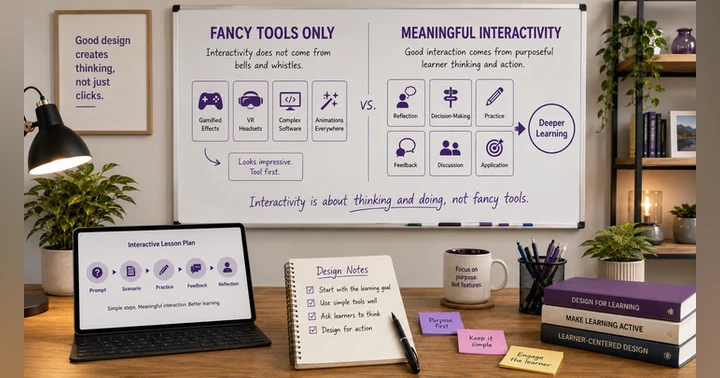
Interactivity is one of those words that sounds obvious until you try to design for it. If you’ve ever felt pressure to add branching scenarios, animations, or expensive eLearning interactions to prove a course is “engaging,” we’re calling that myth out directly: interactivity does not require fancy tools.
In this episode, Jackie walks you through why this belief has lasted in instructional design and education, especially when stakeholders equate visual polish with learning value. We unpack the hidden problem behind click-heavy courses that still feel passive, and we draw a clear line between decorative interactivity and purposeful engagement. The real measure is not how much learners touch the screen. It’s whether they are thinking, deciding, practicing, reflecting, and applying in ways that match the learning goal.
You’ll leave with practical, low-tech strategies you can use in online learning, classroom training, blended learning, and professional development: reflection prompts that actually drive insight, quick scenarios that create decision-making, self-checks with meaningful feedback, and simple discussion structures that move learners from exposure to performance. Jackie also shares a myth reset challenge to help you review one lesson or module and redesign it around the learner actions that matter most.
If you find this helpful, subscribe to the podcast, share the episode with a colleague, and leave a review so more instructional designers and educators can build better learning experiences. What’s one “simple” interaction you’ve used that created real engagement?
🔗 Episode Links
Please check out the resource mentioned in the episode. Enjoy!
Myth Reset Case File: Low-Tech Interactivity
Join PodMatch!
Use the link to join PodMatch, a place for hosts and guests to connect.
Disclaimer: This post contains affiliate links. If you make a purchase, I may receive a commission at no extra cost to you.
💟 Designing with Love + allows you to support the show by keeping the mic on and the ideas flowing. Click on the link above to provide your support.
☕ Buy Me a Coffee is another way you can support the show, either as a one-time gift or through a monthly subscription.
🗣️ Want to be a guest on Designing with Love? Send Jackie Pelegrin a message on PodMatch, here: Be a guest on the show
🌐 Check out the show's website here: Designing with Love
📱 Send a text to the show by clicking the Send Jackie a Text link above.
👍🏼 Please make sure to like and share this episode with others. Here's to great learning!
Frequently Asked Questions
Does interactivity require fancy tools?
No, interactivity is not about tool complexity. It is about whether learners are actively thinking, deciding, practicing, reflecting, or applying concepts.
Why do instructional designers rely on fancy tools?
Fancy tools are highly visible and polished, which often leads stakeholders to mistakenly equate visual flashiness with strong instructional value.
What are some low-tech ways to create interactivity?
You can create meaningful interaction using reflection prompts, short workplace scenarios, decision points, checklists, worksheets, and peer discussions.
How can you tell if a digital course is truly interactive?
A course is truly interactive when learners are actively making choices and processing meaning, rather than just passively clicking through screens or dragging and dropping without understanding.
Welcome & Series Setup
Jackie Pelegrin
Hello, and welcome to the Designing with Love Podcast. I am your host, Jackie Pellegrin, where my goal is to bring you information, tips, and tricks as an instructional designer. Hello, instructional designers and educators. Welcome to episode 149 of the Designing with Love Podcast. Today we're continuing our series called Myths in Instructional Design and Education, where we unpack common beliefs that shape how we design, teach, train, and support learning. In the last episode, we challenged the myth that AI will replace instructional designers. We talked about why AI can support parts of the design process, but human judgment, context, ethics, and learner-centered design decision making still matter. In this episode, we're looking at another common myth. Interactivity requires fancy tools. This myth can show up when we assume that learning is only interactive if it includes advanced software, branching platforms, simulations, animations, drag and drop activities, or expensive authoring tools. But interactivity is not about how flashy the tool is. It is about what learners are invited to think about, decide, practice, reflect on, or apply. So grab your notebook, a cup of coffee, and settle in as we explore this topic together. Before we jump in, here's how this series will work. Each episode will focus on one common myth, why it has lasted, what we know instead, and how we can make stronger design decisions moving forward.
Why Fancy Tools Look Convincing
Jackie Pelegrin
Today's myth is interactivity requires fancy tools. At first, this idea can sound believable. When we hear the word interactive, we may picture polished e-learning modules, clickable scenarios, simulations, animations, game-based activities, or complex digital platforms. And those tools can be useful. They can create meaningful practice, feedback, decision making, and exploration when they are designed well. But the problem begins when we confuse tool complexity with learning interaction. A fancy interaction is not automatically meaningful. A learner can click through several screens and still not think deeply. A learner can drag and drop answers without understanding why those answers matter. A learner can complete a beautiful simulation and still miss the core concept if the experience is not aligned with the goal. Interactivity is not about how many things learners click. It is about how meaningfully learners engage with the learning task. So why has this myth lasted for so long? One reason is that fancy tools are visible. They look polished, modern, and impressive. When stakeholders see a highly interactive module, it can feel like strong design is happening. But visual polish is not the same as instructional value. Another reason this myth persists is that many people associate interactivity with technology. If an activity does not involve a digital tool, it may be dismissed as too simple. But simple does not mean shallow. A reflection question, discussion prompt, case example, decision point, checklist, worksheet, peer conversation, or short scenario can be deeply interactive when they ask learners to think and respond with purpose. This myth also persists because designers may feel pressure to make learning feel more engaging. And when that pressure shows up, tools can seem like the answer. But the tool should not be the starting point. The learning goal should be the starting point. Here is where we need to shift the conversation. The issue is not that tools do not matter. Tools can absolutely matter. The issue is that interactivity depends on the learning experience,
What Interactivity Really Means
Jackie Pelegrin
not the tool alone. A more accurate way to think about it is this. Interactivity does not require fancy tools. Interactivity happens when learners actively think, decide, practice, reflect, respond, or apply. A low tech activity can be interactive if it requires learners to make meaning. A high tech activity can be passive if learners are only clicking without thinking. The real question is not what tool can make this interactive? The better question is what should learners do with the content? Should they compare examples? Should they make a decision? Should they identify a mistake? Should they reflect on their own experience? Should they apply a concept to a real situation? Should they practice a skill and receive feedback? Once we know what learners need to do, we can choose the simplest tool or strategy that supports that interaction. Sometimes that may be an authoring tool. Sometimes it may be a discussion board. Sometimes it may be a shared document, a worksheet, a checklist, a scenario, a reflection prompt, or a conversation. The tool matters less than the thinking it supports. So what does this mean for us as instructional designers, educators, trainers, or learning leaders? It means we need to move from tool-driven interactivity to purpose-driven interactivity. Instead of asking, what interactive tool should I use, we might ask, what kind of learner action would support the goal? Instead of asking, how can I make this look interactive? We might ask, how can I make this mentally active? Instead of asking how many clicks can I add, we might ask, where do learners need to make a decision, practice, reflect, or receive feedback. This shift helps us design interactions that are meaningful instead of decorative. For example, if learners need to recognize a problem, we can give them a short case and ask them to identify what went wrong. If learners need to make a decision, we can present two realistic options and ask them to choose and explain why. If learners need to apply a concept, we can give them a workplace scenario or classroom situation. If learners need to reflect, we can ask them to connect the idea to their own practice.
Simple Prompts That Create Action
Jackie Pelegrin
If learners need to improve a skill, we can give them practice with feedback. None of those require fancy tools. They require a clear goal, a purposeful prompt, and a meaningful response. The goal is not to make learning look interactive, the goal is to make learning active, useful, and connected to performance. Here's today's myth reset. Instead of believing interactivity requires fancy tools, remember that interactivity is created through meaningful learner action, not tool complexity. Fancy tools can support interactivity, but they are not required for it. Strong interaction can happen through reflection, discussion, decision making, practice, feedback, scenarios, examples, questions, and application. This week, look at one lesson, module, activity, or training experience and ask yourself, are learners interacting with the learning in a meaningful way, or are they simply interacting with the screen? That question can help us move from decorative interactivity to purposeful engagement. Today we challenged the myth that interactivity requires fancy tools. We looked at why this belief has lasted, what it gets wrong, and how we can replace it with a more practical and purposeful design approach. Your myth reset challenge this week is to review one learning experience that feels passive. Ask yourself, what is the learning goal? What should learners think about, practice, decide, reflect on, or apply? Where could learners make a meaningful choice? Where could learners receive feedback? What simple tool or strategy could support that interaction? Then choose one improvement you can make. Maybe you add a reflection prompt, create a short scenario, include a decision point, ask learners to compare examples, add a self-check, build in peer discussion, or replace passive content with a practice activity. The goal is not to use the fanciest tool. The goal is to create the right kind of interaction for the learning purpose. In the next episode, we'll continue
Myth Reset Challenge & Closing
Jackie Pelegrin
the series by looking at another common myth. Class size doesn't affect learning quality. Before I conclude this episode, here's an inspiring quote from Aristotle. For the things we have to learn before we can do them, we learn by doing them. That quote is a helpful reminder for this myth because interactivity is really about giving learners meaningful opportunities to do something with what they are learning. Sometimes that doing happens through a sophisticated tool, but sometimes it happens through a question, a conversation, a scenario, a checklist, a reflection, or a decision. When we design interactivity with purpose, we help learners move beyond passive exposure and into practice, thinking, and application. If this episode gave you something to think about, I'd love for you to share it with another educator, instructional designer, trainer, or learning leader who is ready to rethink what really works in learning. And don't forget to check out the companion myth reset case file for this episode. It will help you investigate the myth, review the design shift, and apply this week's challenge to your own course, lesson, module, or training experience. Thank you for joining me today as we opened another case in our myths and instructional design and education series. As you move through the week, I hope this episode encourages you to pause before accepting a familiar belief as fact. Sometimes the best design decisions begin when we question what we have always assumed to be true. Until next time, keep learning, keep questioning, and keep designing with love. Thank you for taking some time to listen to this podcast episode today. Your support means the world to me. If you'd like to help keep the podcast going, you can share it with a friend or colleague, leave a heartfelt review, or offer a monetary contribution. Every act of support, big or small, makes a difference, and I'm truly thankful for you.