Apple Podcasts
 Spotify
 Youtube Music
 Amazon Music
 iHeartRadio
 Podcast Addict
 PocketCasts
  Podchaser
  Deezer
  PlayerFM
  Castro
  Castbox
  Goodpods
 The Future of Learning Starts Now: What 2027 Demands from Designers

Key Takeaways
- Future-ready learning is not about chasing shiny tech trends, but rather about designing experiences that help people grow, adapt, and apply their knowledge in real contexts.
- Instructional designers must shift their focus from mere information delivery and content coverage to active capability building and skill development.
- In an era where AI can quickly generate polished work, assessments must evolve to capture the learner's thinking process, reasoning, choices, and growth rather than just a final product.
- Technology should always serve the human-centered learning experience rather than becoming the central focus of the design.
- Educators can evaluate any course or activity immediately using a simple three-question design lens: identifying the capability being built, the method of practice, and how progress will be measured.
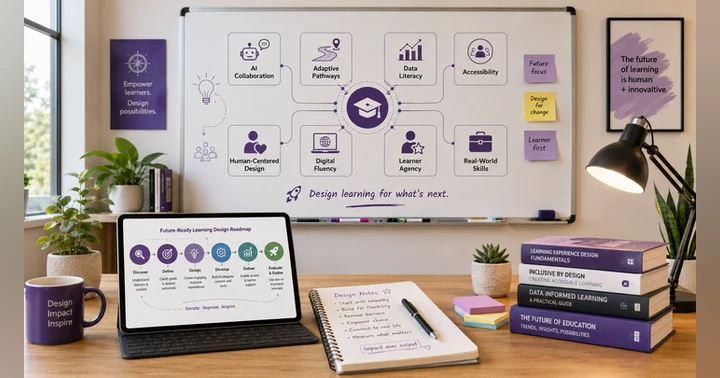
2027 is closer than it feels, and the future of learning is already showing up in the tools we use, the questions learners ask, and the pressure to prove real value in education and training. Jackie is kicking off a new 14-part series, Future-Ready Learning, with a practical challenge for instructional designers and educators: stop treating “the future” like a shiny tech wishlist and start designing learning that helps people grow, adapt, and apply what they know in real contexts.
We dig into three shifts that define future-ready learning design. First, we move from information delivery to skill development by building practice into the experience: problem-solving, communication, collaboration, critical thinking, ethical decision-making, digital literacy, and AI literacy. Second, we move from passive assessment to meaningful evidence of learning. In a world where AI can generate polished work fast, we need assessment strategies that show process, reasoning, choices, revision, and growth, not just a final product.
Third, we move from technology-first design to human-centered design. Tools can personalize practice, increase access, and save time, but they should never matter more than the learner. Jackie shares a simple three-question “2027 design lens” you can use immediately to check any course, lesson, training, or activity: what capability are we building, how will learners practice it, and how will we know they’re progressing?
If you want learning experiences that stay ethical, accessible, and useful as AI reshapes the landscape, this is your starting point. Subscribe, share this with a fellow educator or designer, and leave a review so more people can design what comes next.
🔗 Episode Links
Please check out the resource mentioned in the episode. Enjoy!
Future-Ready Design Brief: The 2027 Design Lens
Join PodMatch!
Use the link to join PodMatch, a place for hosts and guests to connect.
Disclaimer: This post contains affiliate links. If you make a purchase, I may receive a commission at no extra cost to you.
💟 Designing with Love + allows you to support the show by keeping the mic on and the ideas flowing. Click on the link above to provide your support.
☕ Buy Me a Coffee is another way you can support the show, either as a one-time gift or through a monthly subscription.
🗣️ Want to be a guest on Designing with Love? Send Jackie Pelegrin a message on PodMatch, here: Be a guest on the show
🌐 Check out the show's website here: Designing with Love
📱 Send a text to the show by clicking the Send Jackie a Text link above.
👍🏼 Please make sure to like and share this episode with others. Here's to great learning!
Frequently Asked Questions
What is future-ready learning in instructional design?
Future-ready learning is an approach to designing education and training that moves beyond traditional content coverage to focus on practical skill development, critical thinking, ethical decision-making, and human-centered design in a rapidly changing technological landscape.
What three shifts do instructional designers need to make for 2027?
The three critical shifts required are moving from information delivery to skill development, transitioning from passive assessments to meaningful evidence of learning, and shifting from technology-first design to human-centered design.
How can educators assess student learning effectively when AI can generate polished work?
Educators can design assessments that measure the learner's process, reasoning, and choices rather than just the final product. Examples include scenario-based responses, reflections on revision, portfolio artifacts, and explanations of the learner's workflow.
What is the three-question 2027 design lens for instructional designers?
The three-question design check asks: What capability or skill is this helping learners build? How will learners practice or apply that skill? And how will we know if they are making progress?
Welcome & Series Launch
Jackie Pelegrin
Hello, and welcome to the Designing with Love Podcast. I am your host, Jackie Pellegrin, where my goal is to bring you information, tips, and tricks as an instructional designer. Hello, instructional designers and educators. Welcome to episode 155 of the Designing with Love Podcast. Today we are beginning a brand new 14-episode series called Future Ready Learning, Designing Education for What Comes Next. I'm really excited about this series because we are going to be looking ahead, not in a let's predict the future with the crystal ball kind of way, but in a practical, thoughtful, human-centered way. Because the future of learning is not something that suddenly arrives one day. It is already showing up in the tools we use, the questions our learners are asking, the expectations workplaces are placing on education, and the decisions we are making as instructional designers, educators, and learning leaders. In this series, we are going to explore what it means to design learning that is flexible, ethical, accessible, skills focused, and deeply human in a world shaped by artificial intelligence, changing learner needs, new technologies, and ongoing uncertainty. Today's episode is our starting point. We are asking, what does 2027 demand from designers? Not what does it demand from us five years from now, not someday, not eventually, but soon, very soon. So grab your notebook, a cup of coffee, and settle in as we explore this topic together.
Future-Ready Learning Beyond Tools
Jackie Pelegrin
When we talk about the future of learning, it can be tempting to think about shiny tools first. We might think about artificial intelligence, adaptive learning, virtual simulations, automated feedback, learning analytics, or new digital tools that promise to make learning faster, smarter, or more personalized. Yes, those things matter. But future ready learning is not just about the tools. It is about the expectations that come with them. Learners are expecting more flexibility. Employers are expecting stronger skill development. Institutions are expecting evidence of value. Faculty and staff are being asked to do more with limited time. And instructional designers are being asked to connect all of these moving pieces in ways that actually support learning. This means our role is shifting. We are not just designing courses, slides, modules, or activities. We are designing learning experiences that help people build confidence, practice decision making, apply skills, and adapt to new situations. So as we begin this series, I want to frame future ready learning in this way. Future ready learning is not about chasing every new trend. It is about designing learning that helps people grow, adapt, and use what they know in meaningful ways. That is the heart of this series. So why does this matter right now? It matters because 2027 is not far away. And the learners we are designing for are already living in a world where information is everywhere, technology is moving quickly, and the ability to learn, unlearn, and relearn is becoming more important. In many learning environments, simply giving people more content is no longer enough. Learners need opportunities to practice. They need feedback, clarity, support, and learning experiences that connect to real problems, real decisions, and real contexts. This is especially important as AI becomes more common in education and work. AI can help learners brainstorm, summarize, draft, analyze, and create. But it also raises important questions about accuracy, ethics, bias, authorship, and judgment. That means our designs have to do more than deliver information. They have to help learners think critically about how they use information. And that brings us to one of the biggest shifts for instructional designers and educators. We have to move from content coverage to capability building. Content still matters, but the future of learning requires us to ask what learners will actually be able to do with that content. Can they apply it? Can they explain it? Can they use it to make a decision? Can they transfer it to a new situation? Those are the kinds of outcomes that matter when we are designing for what comes next. So
Three Shifts 2027 Demands
Jackie Pelegrin
what does 2027 demand from designers? In this episode, I want to focus on three major shifts. The first shift is moving from information delivery to skill development. For a long time, many courses and trainings have been built around the question, what information do learners need? That is still an important question, but it cannot be the only question. A future ready designer also asks, what do learners need to practice? This might include problem solving, communication, collaboration, ethical decision making, digital literacy, AI literacy, reflection or critical thinking. For example, if we are designing a lesson on AI use, we do not just want learners to know what AI is. We want them to practice evaluating what an AI generated response is. We want them to notice what might be missing. We want them to think about when AI is helpful and when human judgment is needed. That is a very different learning experience than simply reading about AI. The design shift is this. Do not stop at what learners need to know. Design for what learners need to practice. The second shift is moving from passive assessment to meaningful evidence of learning. This is becoming more important because learners now have access to tools that can help them produce polished work quickly. So if an assignment only asks learners to submit a final product, we may not always see how they got there. Future ready assessment should help us see the learner's thinking, process, choices, and growth. That does not mean every assessment has to be a huge project. It does not mean quizzes disappear, but it does mean we should be more intentional about what we are trying to measure. Are we measuring recall, application, decision making, or reflection? A future ready assessment might include a short explanation of the learner's process, a scenario-based response, a reflection, a revision, a portfolio artifact, or a real world task. The design shift is this. Do not only ask learners to show what they produce, ask them to show how they thought. The third shift is moving from technology first design to human-centered design. This one is especially important. As new tools become available, it can be tempting to start with the technology. We might ask, how can I use this tool? Or how can I add AI to this course? Or how can I make this more innovative? But future ready design starts with people. Who are the learners? What do they need? What barriers might they face? What kind of support will help them succeed? Technology can absolutely support learning. It can help us create examples, personalize practice, increase access, provide feedback, and save time. But technology should serve the learning experience. It should not become the center of it. A future ready designer keeps asking whether the design is clear, accessible, ethical, useful, and supportive. The design shift is this. Do not design around the tool, design around the learner. As
The Three-Question Design Check
Jackie Pelegrin
we begin this series, I want to give you a simple design check you can use right away. The next time you are designing or revising a course, lesson, training, or activity, pause and look at one part of the experience. Then ask yourself three questions. What skill or capability is this helping learners build? How will learners practice or apply that skill? How will I know if they are making progress? That's it. Three questions, not twenty, not a full redesign, just a quick check. Because future ready learning does not always begin with a complete overhaul. Sometimes it begins with one small design decision that makes the learning more meaningful. Maybe you add a short scenario, a reflection prompt, revise an assignment so learners can explain their process, add feedback before the final submission, or give learners a chance to compare examples and make a decision. Small design shifts can make a big difference.
Key Takeaways & Mandela Quote
Jackie Pelegrin
As we wrap up, here are the key takeaways from today's episode. First, future ready learning is not about chasing every new trend. It is about designing learning that helps people grow, adapt, and apply what they know. Second, 2027 demands that designers move from content coverage to capability building. Learners need opportunities to practice, make decisions, and transfer learning into real contexts. Third, assessment needs to show more than a final product. It should help us see learners' thinking, process, and growth. And finally, technology should support human-centered learning. The tool should never matter more than the learner. Before I conclude this episode, here is an inspiring quote by Nelson Mandela. Education is the most powerful weapon which you can use to change the world. This quote aligns beautifully with this episode because as instructional designers and educators, we have an opportunity to help shape that change with care, intention, and purpose. The future of learning will not be built by tools alone. It will be built by people who are willing to ask better questions, design better experiences, and keep learners at the center. To help you apply what we discussed today, I've created an interactive companion resource called Future Ready Design Brief, the 2027 Design Lens. This resource will walk you through a simple design check to help you think about the skills, practice opportunities, and evidence of learning built into one course, lesson, training, or activity you are currently designing or revising. If this episode helped you think differently about the future of learning, I encourage you to share it with another educator, instructional designer, trainer, or learning leader who is thinking about what comes next. In the next episode of this series, we will begin looking more closely at one of the biggest forces shaping education and training right now, artificial intelligence and what it means for future-ready learning design. Thank you for joining me today for this first episode in this series. Until next time, keep learning, keep growing, and keep designing with love.
Resources & Ways to Support
Jackie Pelegrin
Thank you for taking some time to listen to this podcast episode today. Your support means the world to me. If you'd like to help keep the podcast going, you can share it with a friend or colleague, leave a heartfelt review, or offer a monetary contribution. Every act of support, big or small, makes a difference, and I'm truly thankful for you.