Apple Podcasts
 Spotify
 Youtube Music
 Amazon Music
 iHeartRadio
 Podcast Addict
 PocketCasts
  Podchaser
  Deezer
  PlayerFM
  Castro
  Castbox
  Goodpods
 Myth: AI Will Replace Instructional Designers

Key Takeaways
- The AI instructional design replacement myth persists largely because AI outputs like course outlines and quizzes are highly visible, while the deep strategic work of instructional design remains hidden.
- Instructional design is much more than fast content creation; it involves understanding learners, analyzing needs, collaborating with stakeholders, and making ethical decisions.
- AI functions best as a tool to support early-stage tasks like brainstorming, drafting, and summarizing rather than as a replacement for human judgment.
- Moving from replacement thinking to partnership thinking allows instructional designers to ask better questions about task support versus human expertise.
- Designers must actively evaluate AI outputs for accuracy, bias, accessibility, privacy, and alignment to protect the integrity of the learning experience.
- The weekly challenge encourages educators to audit one AI task in their workflow, add necessary context, and apply a rigorous review checklist for continuous improvement.
AI can generate a course outline, a script, and a quiz in seconds, so it’s easy to wonder if instructional designers are next on the replacement list. We slow that fear down and look at what’s actually happening when AI enters the learning design workflow, and why “fast content” is not the same thing as effective instruction.
We unpack the myth “AI will replace instructional designers” and name the reason it sticks: AI outputs are visible, while the real work of instructional design often isn’t. I talk through what sits beneath the deliverables: understanding learners, analyzing needs, aligning with real goals, building practice and feedback, collaborating with stakeholders, supporting accessibility, and evaluating whether learning happened. AI can support pieces of this, but it can’t own the responsibility, the trade-offs, or the human judgment required to design learning that is accurate, inclusive, ethical, and useful.
Then we shift into partnership thinking. Instead of asking “Will AI take my job?” we ask better questions: Which tasks can AI support? Which decisions require human expertise? How do we review AI output for accuracy, bias, accessibility, privacy, and alignment? You’ll leave with a simple weekly challenge to audit one place you use (or want to use) AI and make one concrete improvement, whether that’s a stronger prompt, more context, or a clearer review checklist.
If you found this helpful, subscribe to the podcast, share it with a colleague, and leave a review so more educators and learning leaders can design with care in the age of AI.
🔗 Episode Links
Please check out the resource mentioned in the episode. Enjoy!
Myth Reset Case File: AI and the Future of Instructional Design
Join PodMatch!
Use the link to join PodMatch, a place for hosts and guests to connect.
Disclaimer: This post contains affiliate links. If you make a purchase, I may receive a commission at no extra cost to you.
💟 Designing with Love + allows you to support the show by keeping the mic on and the ideas flowing. Click on the link above to provide your support.
☕ Buy Me a Coffee is another way you can support the show, either as a one-time gift or through a monthly subscription.
🗣️ Want to be a guest on Designing with Love? Send Jackie Pelegrin a message on PodMatch, here: Be a guest on the show
🌐 Check out the show's website here: Designing with Love
📱 Send a text to the show by clicking the Send Jackie a Text link above.
👍🏼 Please make sure to like and share this episode with others. Here's to great learning!
Frequently Asked Questions
Will AI replace instructional designers?
No, AI will not replace instructional designers. While AI can accelerate tasks like drafting and brainstorming, it lacks the human judgment, empathy, and ethical responsibility needed to design effective learning experiences.
Why does the AI instructional design replacement myth exist?
The myth exists because AI outputs are highly visible and fast, leading people to mistakenly believe that instructional design is solely about content production rather than learner analysis, strategy, and alignment.
What parts of the instructional design process can AI actually help with?
AI can support early-stage tasks such as generating first drafts, summarizing source material, creating practice questions, brainstorming ideas, and suggesting alternate explanations.
What risks are associated with using AI in instructional design?
AI can introduce risks such as inaccurate information, inherent biases from training data, missed contextual nuances, and potential privacy or accessibility issues that require human oversight to correct.
Welcome & Series Setup
Jackie Pelegrin
Hello, and welcome to the Designing with Love Podcast. I am your host, Jackie Pellegrin, where my goal is to bring you information, tips, and tricks as an instructional designer. Hello, instructional designers and educators. Welcome to episode 147 of the Designing with Love Podcast. Today we're continuing our series called Myths in Instructional Design in Education, where we unpack common beliefs that shape how we design, teach, train, and support learning. In the last episode, we challenged the myth that engagement means entertainment. We talked about why meaningful engagement is about helping learners connect, think, practice, and apply, not simply keeping them entertained. In this episode, we're looking at another common myth. AI will replace instructional designers. This myth can show up when people see artificial intelligence tools generate outlines, scripts, quizzes, scenarios, images, summaries, or lesson ideas in seconds. And yes, AI can support parts of the design process. But instructional design is not just producing content quickly, it is about making thoughtful decisions that support learners, goals, context, ethics, accessibility, and outcomes. So grab your notebook, a cup of coffee, and settle in as we explore this topic together. Before we jump in, here's how this series will work. Each episode will focus on one common myth, why it has lasted, what we know instead, and how we can make stronger design decisions moving forward.
The Myth That AI Replaces IDs
Jackie Pelegrin
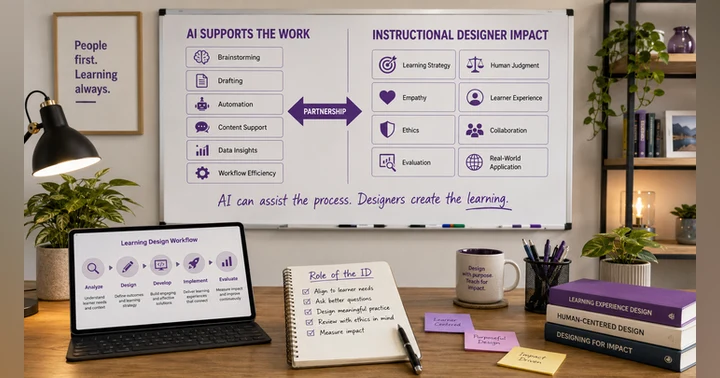
Today's myth is AI will replace instructional designers. At first, this idea can sound logical. AI tools can draft content, generate ideas, summarize information, create practice questions, suggest activities, analyze text, and speed up parts of the workflow. When people see those outputs, it can create the impression that instructional design is becoming automated, but that assumption usually comes from a narrow view of what instructional designers actually do. If instructional design is reduced to writing slides, drafting scripts, or building quizzes, then AI may seem like a replacement. But instructional design is much more than creating deliverables. It involves understanding learners, analyzing needs, collaborating with stakeholders, making design decisions, aligning outcomes, creating practice, planning feedback, supporting accessibility, and evaluating whether learning actually happened. AI can assist with pieces of that work, but it does not replace the human judgment behind the work.
Why the Myth Persists
Jackie Pelegrin
So why has this myth lasted for so long? One reason is that AI outputs are highly visible. When a tool generates a course outline, a quiz, or a draft script quickly, it looks like the work is done, but the visible output is only one part of instructional design. The deeper work is asking whether that output is accurate, aligned, inclusive, ethical, useful, and appropriate for the learner and context. Another reason this myth persists is that content creation is often mistaken for instructional design. If people think instructional designers mainly produce content, they may assume AI can take over the role. But content is not the same as learning. A polished module is not automatically effective. A generated quiz is not automatically valid. A scenario is not automatically realistic. A lesson outline is not automatically aligned. This myth also persists because AI can feel intimidating. When tools change quickly, it is natural to wonder what they mean for our roles, our skills, and our future. But fear can make us ask the wrong question. The better question is not will AI replace instructional designers, the better question is how can instructional designers use AI responsibly while strengthening the human parts of the work?
AI Supports Tasks, Humans Lead
Jackie Pelegrin
Here's where we need to shift the conversation. The issue is not that AI does not matter, AI absolutely matters. The issue is that AI is a tool, not a designer. A more accurate way to think about it is this. AI will not replace the need for instructional design judgment. It will change how some parts of the design process are supported, accelerated, questioned, and reviewed. AI can help brainstorm ideas, it can help create first drafts, it can help summarize source material, it can help generate examples, scenarios, practice questions, or alternate explanations. It can help designers move faster through some early stage tasks. But AI does not know the learner the way we know the learner. It does not understand organizational culture unless we provide that context. It does not automatically know what is accurate, appropriate, accessible, ethical, or aligned. It does not replace the conversations we have with subject matter experts, stakeholders, facilitators, and learners. It does not decide what trade-offs are acceptable. It does not carry responsibility for the learning experience. Human designers are still needed to ask better questions, evaluate outputs, protect learners, make ethical decisions, and connect the design to real goals. AI can assist the work, but humans still need to lead the learning design.
Partnership Mindset & Better Questions
Jackie Pelegrin
So what does this mean for us as instructional designers, educators, trainers, or learning leaders? It means we need to move from replacement thinking to partnership thinking. Instead of asking, will AI take over this work? We might ask, which parts of the work can AI support and which parts require human judgment? Instead of asking, how can I use AI to make this faster? We might ask, how can I use AI to make this better, clearer, more inclusive, or more useful? Instead of asking, can AI create this? We might ask, should AI help create this and how will I review it?
Risks: Accuracy, Bias, & Privacy
Jackie Pelegrin
This shift matters because AI can be helpful, but it can also introduce risk. It can generate information that sounds confident but maybe inaccurate. It can reflect bias in the data it learned from. It can miss context. It can create content that looks polished but does not align with the learning goal. This is why the designer's role becomes even more important. We need to evaluate AI outputs. We need to check for accuracy. We need to review for bias and accessibility. We need to protect learner data and follow organizational policies. We need to make sure the learning experience still reflects sound instructional design. The goal is not to compete with AI. The goal is to use AI thoughtfully while strengthening the human-centered work AI cannot own for us.
Myth Reset & Weekly Challenge
Jackie Pelegrin
Here's today's myth reset. Instead of believing AI will replace instructional designers, remember that AI can support instructional design tasks, but human designers are still needed to guide, evaluate, contextualize, and humanize the learning experience. AI may change parts of the workflow. It may speed up drafting, brainstorming, summarizing, and revising. But strong instructional design still requires empathy, ethics, context, collaboration, strategy, accessibility, and judgment. This week, look at one part of your design process and ask yourself, is this a task AI can support? Or is this a decision that requires human judgment? That question can help us use AI with clarity instead of fear. Today, we challenged the myth that AI will replace instructional designers. We looked at why this belief has lasted, what it gets wrong, and how we can replace it with a more thoughtful and human-centered approach. Your myth reset challenge this week is to review one instructional design task where you are currently using AI or considering using AI. Ask yourself, what is the purpose of using AI here? What context does AI need from me? What parts of the output need human review? What risks should I check for, such as accuracy, bias, accessibility, privacy, or alignment? Then choose one improvement you can make. Maybe you revise your prompt, add more context, create a review checklist, verify the information, adjust the tone, check accessibility, or decide that a task needs more human input than AI support. The goal is not to avoid AI. The goal is to use AI responsibly, intentionally, and in service of better learning for our learners.
Next Myth, Quote, & Closing CTA
Jackie Pelegrin
In the next episode, we'll continue the series by looking at another common myth. Interactivity requires fancy tools. Before I conclude this episode, here's an inspiring quote from Steve Jobs. What a computer is to me, is it's the most remarkable tool that we've ever come up with, and it's the equivalent of a bicycle for our minds. That quote is a helpful reminder for this myth because AI, like other forms of technology, should extend human ability, not erase human judgment. For instructional designers, AI can help us move faster, brainstorm ideas, draft content, and explore possibilities. But we still need human expertise to ask better questions, understand learners, evaluate outputs, protect privacy, check for bias, support accessibility, and design learning experiences with care. When we use AI thoughtfully, we can spend less time starting from a blank page and more time improving the decisions that matter most. If this episode gave you something to think about, I'd love for you to share it with another educator, instructional designer, trainer, or learning leader who is ready to rethink what really works in learning. And don't forget to check out the companion myth reset case file for this episode. It will help you investigate the myth, review the design shift, and apply this week's challenge to your own course, lesson, module, or training experience. Thank you for joining me today as we open another case in our myths and instructional design and education series. As you move through the week, I hope this episode encourages you to pause before accepting a familiar belief as fact. Sometimes the best design decisions begin when we question what we have always assumed to be true. Until next time, keep learning, keep questioning, and keep designing with love. Thank you for taking some time to listen to this podcast episode today. Your support means the world to me. If you'd like to help keep the podcast going, you can share it with a friend or colleague, leave a heartfelt review, or offer a monetary contribution. Every act of support, big or small, makes a difference, and I'm truly thankful for you.