Apple Podcasts

 Spotify

 Youtube Music

 Amazon Music

 iHeartRadio

 Podcast Addict

 PocketCasts
 Podchaser
 Deezer
 PlayerFM
 Castro
 Castbox
 Goodpods
Microlearning 2.0: Beyond Short Videos and Quick Tips

Key Takeaways
- True microlearning goes beyond simply shrinking content or producing short videos, focusing instead on creating purposeful learning moments that support understanding, practice, and application.
- The first design shift in Microlearning 2.0 requires moving away from rigid time limits and instead anchoring every small learning moment around a focused, specific outcome.
- Effective microlearning must transition adult learners from passive consumption to active participation by incorporating retrieval practices, scenarios, decisions, or reflections.
- Microlearning should never exist as an isolated nugget; instead, it must connect intentionally to a larger learning journey, performance need, or broader skill set.
- You can evaluate any learning asset using the Microlearning 2.0 check by asking three simple questions: Is it focused? Does the learner do something? Where does it connect?
In this episode, Jackie walks through what she calls Microlearning 2.0, which is a future-ready approach that treats microlearning as small, purposeful learning moments that help people understand, practice, remember, or apply something useful. We talk about why this matters for adult learners in busy workplaces and higher education, especially when someone needs help at the moment of need. Instead of replaying an entire course, a learner may only need a checklist before a difficult conversation, a quick retrieval practice prompt to reinforce a concept, or a short scenario to sharpen decision-making.
Then, Jackie shares three practical design shifts for instructional design and training: moving from short content to focused outcomes, moving from consumption to action, and moving from isolated nuggets to connected learning pathways. You’ll leave with a simple Microlearning 2.0 check you can run on anything you’re building: Is it focused? Does the learner do something? Where does it connect in the larger learning journey?
If this helped you think beyond short videos and quick tips, subscribe, share the episode with a fellow educator or instructional designer, and leave a review so more learning leaders can find the show.
🔗 Episode Links
Please check out the resource mentioned in the episode. Enjoy!
Future-Ready Design Brief: Microlearning 2.0
Join PodMatch!
Use the link to join PodMatch, a place for hosts and guests to connect.
Disclaimer: This post contains affiliate links. If you make a purchase, I may receive a commission at no extra cost to you.
💟 Designing with Love + allows you to support the show by keeping the mic on and the ideas flowing. Click on the link above to provide your support.
☕ Buy Me a Coffee is another way you can support the show, either as a one-time gift or through a monthly subscription.
🗣️ Want to be a guest on Designing with Love? Send Jackie Pelegrin a message on PodMatch, here: Be a guest on the show
🌐 Check out the show's website here: Designing with Love
📱 Send a text to the show by clicking the Send Jackie a Text link above.
👍🏼 Please make sure to like and share this episode with others. Here's to great learning!
Frequently Asked Questions
What is Microlearning 2.0?
Microlearning 2.0 is a future-ready approach that treats microlearning as small, purposeful learning moments designed to help adult learners understand, practice, remember, or apply something useful at the point of need.
How do you design effective microlearning?
Effective microlearning is designed by making three crucial shifts: moving from short content to focused outcomes, transitioning from passive consumption to active learner participation, and linking isolated nuggets to connected learning pathways.
What is the Microlearning 2.0 check?
The Microlearning 2.0 check is a simple three-question evaluation tool asking whether your learning moment is focused on a specific goal, requires the learner to take an active action, and connects properly to a larger learning journey.
Welcome & Series Context
Jackie Pelegrin
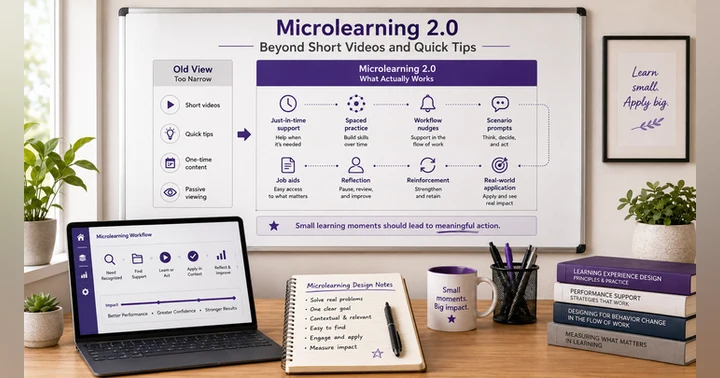
Hello and welcome to the Designing with Love Podcast. I am your host, Jackie Pellegrin, where my goal is to bring you information, tips, and tricks as an instructional designer. Hello, instructional designers and educators. Welcome to episode 163 of the Designing with Love Podcast. Today, we are continuing our series, Future Ready Learning: Designing Education for What Comes Next. In our last episode, we explored adaptive pathways and how we can give learners different forms of support while still guiding everyone toward shared learning goals. Today, we are turning our attention to another idea that has been around for a while, but is continuing to evolve microlearning. When you hear the word microlearning, what comes to mind? Maybe a two-minute video, a quick tip, a flashcard, a short infographic, or maybe one of those bite-sized lessons you complete while waiting for your coffee. But if we define microlearning only by how short it is, we miss what makes it useful. Future ready microlearning is not simply about taking a 30-minute lesson and chopping it into six five-minute pieces. And it's definitely not about shrinking content until it fits on a phone screen. It's about creating small, focused learning experiences that help someone understand, practice, remember, or apply something useful. Today we are looking at what I am calling MicroLearning 2.0, which means moving beyond short videos and quick tips toward purposeful learning moments that connect to practice, performance, and larger learning experiences. So grab your notebook, a cup of coffee, and settle in as we explore this topic together.
Microlearning Beyond Short Content
Jackie Pelegrin
Here's today's future ready signal. Learning is becoming less confined to one course, one classroom, or one scheduled training event. People learn throughout the day. They search for an answer when they need it. They revisit something they have forgotten. They watch a demonstration before trying a task. They practice a skill in small increments. They receive feedback and try again. And sometimes they need support at the exact moment they are about to apply what they learned. That creates an important opportunity for microlearning. Research on mobile microlearning with adult learners has explored its use in both workplaces and higher education settings as a flexible way to support instructional goals. But the future ready opportunity is bigger than simply making learning shorter. The opportunity is to make learning more focused, more accessible, and better connected to the moment of need. That means we need to move past the idea that microlearning equals short content. A five-minute video can still overload learners. A one-minute tip can still have no clear purpose, and a beautifully designed infographic can still be something learners look at once and immediately forget. The length matters, but the design matters more. So why does this matter? Because our learners are dealing with a lot of information. Courses can be dense, workdays are busy, technology is constantly competing for attention. And when someone needs to remember one specific step or make one decision, going back through an entire hour-long course may not be practical. Microlearning can give us another option. Imagine someone has already completed training on how to conduct a difficult performance conversation. Three weeks later, that person is about to have the actual conversation. They may not need the entire course again. They may need a quick checklist reminding them of the three steps they practice. That is microlearning serving performance. Or imagine learners are studying a complex concept over several weeks. Instead of relying on one large lesson followed by one assessment, we might include a short retrieval activity, examples, many scenarios, or reflection prompts throughout the experience. That is microlearning supporting reinforcement. Microlearning can therefore play different roles. It can introduce, reinforce, provide practice, and refresh. And it can support performance at the moment of need. The important question is not how short can I make this? It is what does the learner need from this small learning moment?
Three Shifts for Microlearning 2.0
Jackie Pelegrin
Today's design shift is this. Move from shrinking content to designing purposeful learning moments. There are three shifts that can help us think about microlearning 2.0. Shift number one, from short content to focused outcomes. The first shift is from measuring microlearning by minutes to designing it around a focused outcome. Research on microlearning commonly emphasizes brevity and focus, often around a specific concept or objective, rather than simply a shorter version of a larger lesson. So before creating the video, infographic, podcast clip, or interactive activity, I would decide the following. What is the one thing this learning moment needs to accomplish? Maybe learners need to reorganize a phishing attempt, the first step in a procedure, distinguish between two concepts, or practice responding to a customer. The focus helps us remove everything that does not serve the purpose. Microlearning shift feels small because the learning goal is focused, not because we arbitrarily stopped after three minutes. Start with one meaningful outcome, then design the smallest experience that supports it. Shift number two, from consumption to action. The second shift is from simply giving learners something short to watch or read toward giving them something meaningful to do. This is where microlearning can become much more powerful. Instead of watch this two-minute video, we might follow it up with choose the best response, identify the problem, try this step, explain what you would do next. The interaction does not need to be complicated. A good microlearning might be a short scenario, one retrieval question, a comparison, a decision point, a worked example, a quick reflection, or a tiny challenge learners apply in the real world. The important thing is that the learner is not just consuming information, they are doing something with it. Shift number three, from isolated nuggets to connected learning. The third shift is from treating microlearning as a collection of random content nuggets to connecting those moments to a larger learning journey. This is a big part of microlearning 2.0. A series of short videos is not automatically a learning strategy. Ten quick tips are still ten disconnected tips if learners cannot see how they fit together. Research examining the pedagogy of microlearning highlights both the design of the individual content and the instructional flow that organizes the learning experience. So we need to think about connection. Where did this microlearning moment come from? What does it prepare the learner to do next? Is it connected to a larger skill? Does it reinforce something learners encountered earlier? Could they access it later when they actually need it? Think of microlearning as a series of stepping stones. Each stone is small, but together they should help the learner move somewhere. Small does not have to mean disconnected.
The Microlearning 2.0 Check
Jackie Pelegrin
Here is something simple you can try this week. Choose one piece of learning content you are designing or something that already exists. Then run it through the micro learning 2.0 check. Ask yourself three questions. Question number one, is it focused? Can clearly describe the one thing this learning moment should help someone know, practice, remember, or do? If there are five different goals competing for attention, it may not be micro yet. Question number two, does the learner do something? Is there an opportunity to retrieve, decide, practice, reflect, compare, or apply? Even one small action can turn passive content into a more meaningful learning moment. Question number three, where does it connect? What comes before or after this? Does it reinforce a larger skill? Does it prepare learners for another task? Could learners return to it when they need support? That connection gives the microlearning moment a reason to exist. Before we close, here is one reflection question to carry with you. Am I making learning shorter or am I making it more focused and useful? Those are not always the same thing. A longer learning experience may sometimes be exactly what learners need. Complex skills require time. Deep thinking requires time. Practice requires time. Feedback also requires time. Microlearning is not the solution to every learning problem. But when learners need a focused explanation, a quick opportunity to practice, a reminder, reinforcement, or support in the moment, microlearning can be incredibly useful. Future ready design is not about making everything smaller, it is about knowing when small works
Reflection, Takeaways, & Next Steps
Jackie Pelegrin
better. As we wrap up, here are the key takeaways from this episode. First, microlearning is more than short videos, quick tips, or bite-sized content. Second, effective microlearning begins with a focused learning outcome, not an arbitrary time limit. Third, microlearning 2.0 moves learners beyond passive consumption by including opportunities to retrieve, practice, decide, reflect, or apply. And finally, individual microlearning experiences should connect to something larger, such as a skill, learner pathway, performance need, or a moment when the learner can actually use what they have learned. The goal is not to make learning as short as possible. The goal is to make every small learning moment worth the learner's time. Here is an inspiring quote by Aristotle. For the things we have to learn before we can do them, we learn by doing them. Even though those words were written long before smartphones, microlearning platforms, or digital learning existed, I think they offer a great reminder for us today. Shorter content is not automatically better learning. Learners still need opportunities to think, practice, connect ideas, and most importantly, to use what they are learning. Microlearning becomes powerful when a small learning moment leads to meaningful action. To help you apply what we discussed today, I've created an interactive companion resource called Future Ready Design Brief, Microlearning 2.0. Inside the brief, you will use the MicroLearning 2.0 check to examine whether a learning moment is focused, active, and connected to a larger purpose. And if this episode helped you think beyond short videos and quick tips, please share it with another educator, instructional designer, trainer, or learning leader who is exploring how to make learning more focused, flexible, and useful. These conversations are better when we are learning and designing together. In the next episode of our Future Ready Learning series, we will continue exploring the shifts shaping how we design education for what comes next. Thank you for joining me today. Until next time, keep learning, keep growing, and keep designing with love. Thank you for taking some time to listen to this podcast episode today. Your support means the world to me. If you'd like to help keep the podcast going, you can share it with a friend or colleague, leave a heartfelt review, or offer a monetary contribution. Every act of support, big or small, makes a difference, and I'm truly thankful for you.